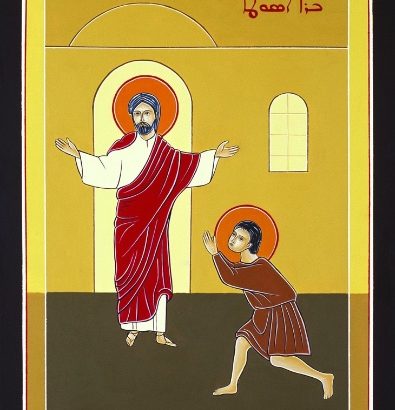
What can we make of the father of the brō ōsuTō, “the glutton son, the prodigal son,” etymologically – the unsaved son (see my earlier post https://www.fryuhanna.com/2022/03/18/sunday-of-the-prodigal-son/)?
I would say that if the son is the “unsaved one,” then the father is the “patient one.” Recall that when the son returned to him, the father saw him from a distance. In other words, the father was watching for him. I do not believe that this was merely a coincidence; that that was the first occasion on which the father went out to see, or that it was an accident, as if the father might have gone out to pick some parsley and it just so happened that the son was coming back at that very moment.
No, the father went out every morning, to take advantage of the first light, he went back in the evening so that he should not lose the advantage of the last of the sun, and he was out there watching at noon in case the son was struggling back in the heat. And in all this, the father was building his strength – building his spiritual strength through patience. The patient one is the strong one. It is the person who loses their temper and lashes out who is weak.
He resisted the temptation to take action and to force the issue. He delivered no ultimatum. He offered no bribe. He waited at home for his son to decide to return of his own volition. And eventually, the son did just that. The unsaved son (which is the radical meaning of the Syriac) was saved when he came to himself and returned home. And when he did return, he met not the gates or the doors, he met the patient father himself – the same father, who when he discovered the jealous reaction of his eldest son, came out to meet him, too.
There is much to ponder on in this story: the son “came to himself,” in the Syriac tradition, this refers to the insight that as we are, when we are in the power of sin, we are estranged from our true selves. To live rightly, we have to rediscover our true selves. What is more, as the Syriac Fathers said, to come to oneself is to come into the presence of God.
Then, when the son returned, the father had his servants kill the fatted calf, which in the Syriac tradition, represents Christ and the Eucharistic sacrifice. The elder son, who was often understood as a symbol of the Jews, complained that he had not even been given a goat – which was a sacrifice of the OT law. The father’s perfectly patient reply was the the elder son had always been with him, and all he (the father) had was his (the son’s). There was no need for the son to exclude himself. Note, too, that we had not been told how the unsaved son spent his inheritance – the sordid details are given only by the jealous elder son. There is a lesson even in this: the sin of detraction is a sin of envy.
There are some other characters in the parable. What of the unsaved son’s fair-weather friends? Did they even think of him except perhaps to wistfully wish they could milk more money from him? And the man who gave him work caring for the pigs (a sign that he was among the Gentiles)? Did he think anything but easy come easy go?
More interesting to my mind are the patient father’s servants. They knew what he was like, and perhaps they made efforts to understand him. What was their attitude in telling the elder son that his brother had returned, and that there would be a feast? Were they wondering what changes would come? I cannot imagine that they were not touched by his generosity and goodness. They must have rejoiced in the warmth of their master.
I think that each of us, in some way, has all these characters inside us. We cannot be just like the father, for He is the Father. But we can emulate his patience, compassion, mercy, and love.
Finally, there is an enigmatic passage in the Maronite psalm for this feast: the unsaved son is speaking, and he says that his own heart condemned him, but the father was greater than his heart. What does this mean? I think it can be understood in the light of St James 2:13, “Mercy triumphs over justice.” His heart told him that in justice he was not worthy to be the father’s son – but the father’s mercy and compassion was greater.
And so the unsaved son found salvation. May it be.