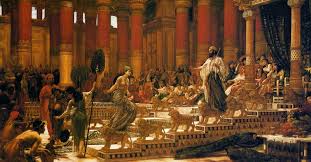
Having studied the concept of the “Fear of God,” which is so central to the Book of Proverbs, let us now examine another major concept in it, that of “Wisdom.” You may have come across some of its astoundingly beautiful and mystic verses in chapter 8 about the female figure of Wisdom:
The Lord possessed me at the beginning of his work, the first of his acts of old. Ages ago I was set up, at the first, before the beginning of the earth. When there were no depths I was brought forth, when there were no springs abounding with water. Before the mountains had been shaped, before the hills, I was brought forth, before he had made the earth with its fields, or the first of the dust of the world. When he established the heavens, I was there; when he drew a circle on the face of the deep, when he made firm the skies above, when he established the fountains of the deep, when he assigned to the sea its limit, so that the waters might not transgress his command, when he marked out the foundations of the earth, then I was beside him, like a master workman, and I was daily his delight, rejoicing before him always, rejoicing in his inhabited world and delighting in the children of man.
“And now, O sons, listen to me: blessed are those who keep my ways. Hear instruction and be wise, and do not neglect it. Blessed is the one who listens to me, watching daily at my gates, waiting beside my doors. For whoever finds me finds life and obtains favour from the Lord, but he who fails to find me injures himself; all who hate me love death.”
We are going to return in a moment to wisdom, for surely we all desire to share in it, and the better idea we have of what wisdom is, the better the chance we may be worthy to find it, and have some wisdom. But even before that, we must consider what this teaches us about God, for implicit in chapter 8 of Proverbs is the idea that before the Creation, before God performed any works, He simply was. How He was, what He experienced, and how there could be a “before” when there was as yet no time, we cannot understand. But I do not think we need to, because the revelation of Scripture is the revelation only of what is comprehensible to our human minds, and even we can grasp that the Being of God is of a type very different from our own being, and so we who are bound to time can understand that His existence is not in time, but how that can be, we cannot imagine.
Very few people who ever purchase a lap-top understand the engineering which produces the machine, but they do not need to. They can learn more or less about how to operate it so that it produces for them the results they wish for. The more they study about the lap-top and the software, the better the use they obtain from it. I think we are in analogous position with God, the Creation, and God’s design for us.
I stress this because this is, I think the super-meaning of this passage. It is not expressly articulated, rather this section begins by speaking about the creation of Wisdom. However, if you ponder it, you will see that for God to have created Wisdom before the creation of the heavens and the earth, then it must follow that He Himself was and must eternally be beyond existence, for our concept of existence implies a world to exist in. And so, with this perspective, we perceive that the whole of the Book is about God and His design of the Creation, as it relates to man and to our place in it, and – to our place beyond this world.
What Wisdom says here is that her creation was the first of God’s acts of creation; and in this respect, her revelation seems closer in expression to the spirit of the first chapter of St John’s Gospel, “In the beginning was the Word,” than it is to Genesis: “In the beginning, God created the heavens and the earth.” Yet, neither is it the same as the logos or Word in St John, for the whole point is that Christ, the Divine Word, was not created, but rather eternally was with and indeed was God. Wisdom, on the other hand, is indeed a creature. We might surmise, then, that when God created the heavens and the earth, He did so through the Word, and that the very first of His creations was Wisdom. This suggests to me that Wisdom existed even before angels and the rebellion of Lucifer and his allies. This, too, I suspect, was done in eternity, before the creation of time itself. But what does it mean to say that something is “done” when there is no time? These mysteries are, I think, fairly conjured in the mind of a contemplative reader, even if they are not raised by Solomon in this Book. Bear in mind, that this work is indeed attributed to Solomon, the wisest of men, and that it is he, not myself or anyone else who introduces the creation before the creation.