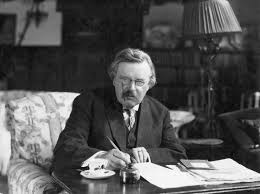
Chesterton published Heretics in 1905, and as a result of the questions he was asked about it, he followed it up with his magnificent Orthodoxy. After all, if the opinions he critiqued in the first were wrong, what were the true opinions? I think that those questions were superficial in one sense, for as we shall see, Chesterton did indeed critique the heretics of the first volume by the standard of truth, and he took considerable pains to express it.The very first chapter of Heretics is titled: “Introductory Remarks on the Importance of Orthodoxy.”
But there still remained two matters which made Orthodoxy advisable: the actual people and ideas he covered in Heretics were time-bound. Most of the names in it are today unknown, so although GKC always appealed to first principles, that appeal is not so powerful when the examples leave us none the wiser. Orthodoxy is far more obviously of general application. Second, there is a difference of effect between the tightly organised and concise positive case put in Orthodoxy and the more wide-ranging and diverse mix of positive and negative in the first book, especially as GKC often leads there with the critique.
Yet, for all that, I consider Heretics to contain as much wisdom as Orthodoxy, and that is not inconsiderable. The basic truth he intended to teach there is, I would say, that all truth is the eternal truth of Christianity, and although fashions and fads may obscure this, blinding us with a cloud of argument and sentiment, the true touchstone for life on earth is the spiritual.
I will not spend much time on the layout of the book, after all, what would it mean to most people that chapter 12 is “Paganism and Mr Lowes Dickinson”? But the contents can be considered as a whole, because the topic is basically how modern culture departs from spiritual truth.
The point of departure is that whereas people once took a humble pride in being orthodox, they now take a very much more sanctimonious and self-congratulatory pride in being what they think of as heretics (3). And yet, the “free thinkers” of today are bound hand and foot to their own conventions and fashions: witness what happened if one questioned the official line during the Covid panic. It is as true today as it was in 1905 that a modern faddist “says with a conscious laugh, ‘I suppose I am very heretical’, and looks round for applause” (4). Or, as he adds, “Revolution itself is too much of a system” (5). The result is, he says, that people care more for the effect they make than for being right.
People are perfectly happy to discuss details of art and architecture, but not to dispute over religion: “He may turn over and explore a million objects, but he must not find that strange object, the universe; for if he does he will have a religion, and be lost. Everything matters – except everything” (5) Society, as a rule, does not believe that the deep matters like religion matter, except in so far as they are to be deplored as “brakes on progress.” Which means that the world really is becoming anti-religious.
GKC was, I think right, to say that when the Liberal movements in society allowed what it called freedom of speech and thought (e.g. the Enlightenment) the notion was that there would be progress in all fields, even in religion and philosophy, but all this came to the end result that these do not matter, and that (I would add) religious coexistence is as easy as passing the requisite laws. The reality that some religions cannot easily coexist, and that secular and atheist philosophies would prove to be even more illiberal and totalitarian than religious ones (at least if we are speaking of the Judaeo-Christian culture) never occurred to anyone – and yet it is so. Who has killed as many as Stalin, Mao, and their successors? The fact that secular philosophies and “Antifascist” movements are so violent and destructive shows that the religious diagnosis of man as fallen is right. People see symptoms and say that the problem is racism, then turn around and are as racist as ever anyone was. The problem is deep in humanity, it is a spiritual disease and the cure is spiritual – not legal, not political (although improvements there will point to spiritual recovery).
As Chesterton points out: “The old restriction meant that only the orthodox were allowed to discuss religion. Modern liberty means that nobody is allowed to discuss it” (7). This is not the entire truth, but there is enough truth in it to make it worth pondering. It is closer to the exact truth to say, “the most practical and important thing about a man is still his view of the universe” (7). I find that over the long haul of life, nothing binds people together so much as their fundamental opinions (as St J.H. Newman observed).
He makes the link to art and culture when he observes that: “General ideals used to dominate literature. They have been driven out by the cry of ‘art for art’s sake’ (8-9). This is why modern art is so meaningless or else political – and its value then depends on one’s agreement or disagreement with the artist’s politics. And speaking of politics: “General ideals used to dominate politics. They have been driven out by the cry of ‘efficiency’ which may roughly be translated as ‘politics for politics’ sake’ “(9). This was all written before the spread of the disease of Marxism: an ideology so closely tied to the negative emotion of resentment that it has the advantage of appealing to what our low and vulgar emotions – always a crowd pleaser unless it is overcome by a spiritual outlook. After Chesterton’s time, the very emptiness of Liberalism left space for the influx of Marxism, and we are reaping the sad results today in political movements of all kinds, although while the left- and right-wings are generally as bad as one another, it tends to be on the right wing where there is something wholesome which can be related to spirituality and religion (not hollowed out by modernism, which equals “progressive” or “Enlightenment” opinion”).