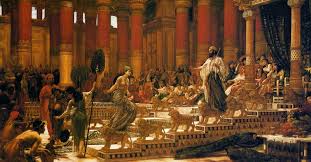
After the prologue and scene-setting, the Book of Job takes the turn which makes it most difficult for us to read or profit from, because each of these kings delivers lengthy speeches and engage in a seemingly circular and pointless argument with Job. Also, it is not entirely clear what they mean. However, the fact that they are kings seems to me to indicate that we are meant to treat their arguments as a sort of parade-ground example of different approaches to the question of suffering and divine justice. These are, I would say, representative views, all of which the Book of Job intends to refute.
The ancient tradition is fairly unanimous in saying that in these speeches there is always something which is true, but not the whole of the truth. While they are trying to help Job, in some respects, this involves being critical of him so that he can achieve a new perspective. But in the end, they do not succeed: it is only when God appears and speaks that the breakthrough comes.
To return to the book, in chapter 3, Job curses the day of his birth, and in accordance with the sort of ideas I have outlined above, says that for a man who knows nothing but suffering, death is welcome relief, for “God has hedged him in” (3:23). Eliphaz speaks, and much of what he says is good, for example, thus in chapter 5 he says:
man is born to labour, and even so the vulture’s young seek the high places. Nevertheless I will beseech the Lord, and will call upon the Lord, the sovereign of all; who does great things and untraceable, glorious things also, and marvellous, of which there is no number: who gives rain upon the earth, sending water on the earth: who exalts the lowly, and raises up them that are lost: frustrating the counsels of the crafty, and their hands shall not perform the truth: (5:7-12)
Job in his reply, offers the sort of observation which Ecclesiastes makes about life under the sun: “Remember then that my life is breath” (7:7); and as with Ecclesiastes, this is only true of life under the sun. King Baldad then takes his turn, basically asserting that God rewards the good and punishes the innocent. Job replies that this is true, but it does not follow that the innocent will suffer no misfortunes for the simple reason that in the final analysis, no one can truly be said to be righteous. This is well expressed in chapter 9:2-3 “how shall a mortal man be just before the Lord? For if he would enter into judgment with him, God would not hearken to him, so that he should answer to one of his charges of a thousand.”
In the course of his reply, Job speaks of the heavens and the sea: in an important and pregnant interpretation, which we shall return to when we come to what God says about Behemoth, St Pope Gregory the Great says that the heavens represent the heavenly life of God’s ministers on earth, and the seas are “this world’s bitterness raging in the destruction of the righteous.” (Wright 50-51), that is, they stand for virtuous and wicked people respectively. But in terms of the narrative of the book, Job then doubts, even denies, God’s justice; and asserts that God destroys both the innocent and the wicked (9:23).
We are now briefly passing through the conversation, sometimes argument, between Job and three kings who come to console him in his misfortune. That part, I think, leans too heavily on the point that no one can really understand why God allows events to unfold as they do, and in particular, that it is a mystery why goodness is not always rewarded and evil not always punished. As I mentioned, the Fathers said that these speeches have some but not all of the truth. We also saw that in many ways the Book of Job is of the same mind as the Book of Ecclesiastes: that life under the sun is vain.
Time and again in this very long exchange between the four speakers, Job’s words prophetically refer to the coming and the sufferings of Christ. However, to my mind, the similarity of this book to Ecclesiastes is paramount, hence in chapter 14, Job states:
For a mortal born of a woman is short lived, and full of wrath. Or he falls like a flower that has bloomed; and he departs like a shadow, and cannot continue. Hast thou not taken account even of him, and caused him to enter into judgment before thee? For who shall be pure from uncleanness? Not even one. (14:1-4)
This passage is also important for its clear reference to the judgment, and to the reality of sin, and that, as St John, if we are all sinners. Job continues to then ask questions about what happens to man after he has been laid in the grave. For example, in verse 12, he says: “So man lies down and rises not again; till the heavens are not more he will not awake or be roused out of his sleep.”
The Fathers see in these passages “prophetic hints of the rebirth of mankind in Christ” (Wright 81). Hesychius of Jerusalem wrote: “By calling death “sleep,” Job has clearly given us the hope for resurrection. However, he says, we will not awake “until heavens are no more.” (Wright 82) This, Hesychius rightly says, refers to the end of time.
After this, Eliphaz responds. As before, some of what he says is worthy and some is not. St Pope Gregory the Great says that, from Eliphaz’s speech, one can learn that the unrighteous attribute arrogance to good people, and cannot imagine that anyone else understands more than they do (Wright, 84-85). Job replies, and then Bildad answers Job, somewhat critically. This provokes Job to defend himself, quite vigorously, in chapter 19. It is here that he utters the famous words: “I know that my Redeemer lives and at last he will stand upon the earth” (v.25). The LXX puts it a little differently: “For I know that he is eternal who is about to deliver me, and to raise up upon the earth my skin that endures these sufferings …” (25-26)
We will continue from here in the next post.