Ancient Antioch: The Background (51st Maronite Podcast)
The Maronite Church declares, in its official documents, that it is an Antiochene Syriac Maronite Church. The Maronite Patriarch is, officially, the Patriarch of Antioch and all the East. Because the Church and he are Maronite, they are ipso facto (by that fact) Catholic, because the Maronite Church is a Church of the Universal Catholic Church. It is one of the twenty-four autocephalous or sui juris Churches which comprise the Catholic Church. The Latin sui juris or sui iuris means “with its own law.” The word “Church” is therefore polysemous, taking its precise meaning from its context.
We should bear in mind that not all of our sources are “primary”, that is contemporary sources, but where they are, these sources are usually considered to be our best. Certainly, they are fundamental where they are available and must be considered first. Let us take as an example the first abbots of the monastery Deir Mar Maroun: there are no surviving sources for the great majority of them, which means that there are be no available primary sources for them. More often than not, we do not even know their names. On the other hand, if we take someone like Blessed Patriarch Dwayhi, there are very many primary sources: documents made by or about him during his own life.
In contrast to primary sources, there are “secondary” sources. These are books written on the basis of primary sources which are not themselves contemporary. For the monks of Dair Mar Maroun, books such as El-Khouri’s are secondary. Modern biographies of our Blessed Patriarch are secondary sources.
However, although this distinction is crystal clear, and quite workable, we would do even better if we distinguished a third class, which we might speak of as “intermediate” sources. These are documents which are not primary, but use older, particularly primary sources which have disappeared. For St Yuhanna Maroun, apart from a small book which some believe he wrote, we could take the work of Patriarch Duwayhi and Joseph Simon Assemani as intermediate, as they use some ancient sources which have now disappeared.
It is desirable to say a little about Antioch, and its role in early Christianity, because as a capital city and centre of culture, Antioch exerted a magnetic influence on events in its vicinity, and understanding this will enable us to make better use of our sources. Many Christians, even many Maronites, know nothing of Antioch, and that is a great shame. Antioch played a noble and unique role in the early Church. It is an honour and a privilege to be children of the Antiochene Church.
1.1. The Pagan City of Antioch
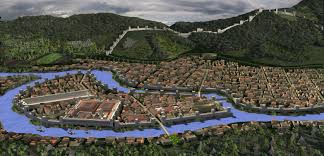
Several cities in the ancient world were named Antioch. The one which we are concerned with is the Antioch which was on the Orontes River, twenty miles from Seleucia, its sea-port, which was on the Mediterranean Sea. Some fifty to fifty-five miles to the East were the cities of Aleppo (then known as Beroea) and Chalcis; and about sixty miles south was Apamaea (a large city which was probably near the ancient Dayr Mar Maroun, the monastery of St Maroun), while sixty miles south on the coast was Laodicea, still an important sea-port in modern Syria. These cities were even further removed from the sea, but cities right on the sea were open to surprise naval attacks. Further, overland routes which went in different directions could meet there, where they would be in contact with the Mediterranean trade, and it had a very good water supply nearby. Antioch therefore had a very good position for both trade and defence.
In May of the year 300B.C., Antioch was founded by the king and general Seleucus Nicator (358-281B.C.), one of the successors of Alexander the Great (356-323B.C. When we speak of “Antioch” we often mean the adjacent countryside as well as the city. As Liebeschuetz says: “There is some ambiguity about the name Antioch. The territory of Antioch comprised the city but also a large rural area administered from it …” The people of Antioch comprised mainly Greeks and Macedonians, but included a number of Jews (many of whom may have been soldiers who were now settling down in retirement), and native Syrians, who probably lived in a separate area either within or without the city walls. There were also some Romans there, although little is known of them. It became the capital city although it had not originally been intended to be so.
To provide an idea of its importance as an ancient city, consider that in the temple of Apollo which Seleucus built was installed “a colossal acrolithic statue of the god … Apollo was shown playing and singing, with lyre in one hand and bowl in the other, wearing a high-girdled chiton, which was gilded and his eyes were formed of two enormous violet stones …” As a cultural centre, Downey says of Antioch that:
… (it) filled with orientalized Greeks and Hellenized Orientals, of all classes and all degrees of education, (and) had come to contain, as part of its normal daily existence, not only the old established Hellenic cults … but the Syrian cults of Baal and the mother-goddess … as well as the mystery cults with their doctrines of salvation, of death and regeneration, and their promises for the after life.
As he also notes, the “large and ancient Jewish community which seems to have felt no great hostility toward the Gentiles, and, in turn, appears not to have been looked upon with any marked degree of disfavour by the Gentiles as a whole, at this time.”
The last pagan inscription from Antioch is dated 367-8. All later inscriptions are Christian. Our concern is with Antioch as a centre of Christianity, and that commences as early as the New Testament age. The point is that we should not think of Antioch as being just another city: it was not. After Rome and Alexandria it was the largest city of the Roman world. It was one of the marvels of that world, and naturally came to be a leading city in the earliest Christianity.