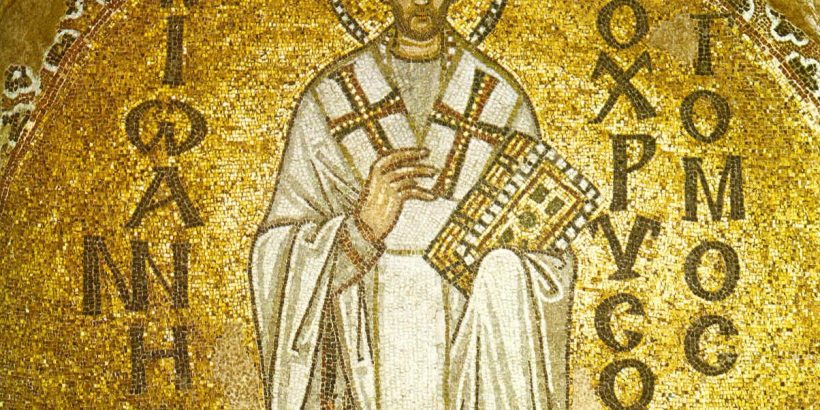
I have introduced St John Chrysostom: https://www.fryuhanna.com/2026/01/16/st-john-chrysostom-life/
I now consider his book On the Priesthood. This is a relatively long work, and was written by Chrysostom not as a homily, but as a book, in six volumes. It is autobiographical, but Chrysostom uses the story of his own life to try and teach the more important lesson: that we must seek for salvation. In parts, it is written as an imaginary dialogue between Chrysostom and Basil, whom we know today as St Basil of Caesarea.
In this respect, the priesthood is central. Its very opening words, in the English translation, are: “I had many genuine and true friends, men who understood the laws of friendship, and faithfully observed them; but out of this large number there was one who excelled all the rest in his attachment to me …”, and this was Basil (I.1) He goes on to say how, although they were well matched in almost everything, such as birth, wealth and personality, when they began to “pursue the blessed life of monks, and the true philosophy”, Basil was better than he was, for Chrysostom was entangled with worldly desires. They remained friends, but did not have as much to do with another as before, since it is impossible for those who have different interests to spend very much time together (I.3).
To understand what the book is about, one needs to compare the opening with the close. It finishes with Chrysostom and Basil together. They both state how much in need of forgiveness they are. They vow to help each other in their spiritual labours. The final words are Chrysostom’s: “… I … led him forth, exhorting him to bear his lot bravely. For I believe, said I, that through Christ who has called you, and set you over his own sheep, you will obtain such assurance from this ministry as to receive me also, if I am in danger at the last day, into your everlasting tabernacle.” (VI.13)
So the book is really a treatise on how friendship can lead to the salvation, or at least the path of salvation, for both friends. Friends support one another, and to offer this support is a priestly office, and it is also the work of the priest to support others in friendship. Further, the priestly ministry is something higher than friendship, but must support it.
Along the way, much is said about the priesthood. The image of the shepherd is taken very seriously: after all, these people lived far closer to the pastoral life than we do. Much is said about being unworthy of the task, especially in respect of his own decision to avoid the priesthood when he was first asked to become priest (e.g. II.4). He stresses how great the dignity of the priesthood is: “… by their agency (i.e. the agency of priests) these rites (the Eucharist) are celebrated, and others nowise inferior to these both in respect of our dignity and our salvation. For they who inhabit the earth and make their abode there are entrusted with the administration of things which are in Heaven … what priests do here below (in confession) God ratifies above. … if no one can enter into the kingdom of Heaven except he be regenerate through water and the Spirit, and he who does not eat the flesh of the Lord and drink His blood is excluded from eternal life, and if all these things are accomplished only by means of those holy hands, I mean the hands of the priest, how will anyone, without these, be able to escape the fire of hell …?” (III.5)
Along the way, Chrysostom makes many other comments all conducing to the path of salvation, e.g. that wrath blinds “the purity of the reason” (III.14), how one can do very well praying and fasting alone, but as soon as one comes among people make mistakes, be incompetent, no good to themselves or others (III.15). In Books IV and V, he says much about the need to be able to preach well, and in Book VI of how higher standards are demanded of priests.
It is a very well written book. The style is rather more flowery than we like today, and he dwells on his points rather than making them quickly and moving on. Yet, there is no questions except that it is a very Catholic book, and gives strong support to Catholic ideas of the priesthood and the bishopric, and all the sacraments. It shows the continuity in the faith.
Finally, of Chrysostom’s letters, the first seventeen, letters of consolation to the deaconess Olympias are considered especially touching. She had lost her husband and become a widow and deaconess, given perhaps to melancholy. His letters to her from his exile are poignant for the fact that although he himself was suffering unjust persecution, he makes it his study to bring her to serenity, offering her fresh perspectives on her own pain, and dismissing his own as unworthy of consideration.