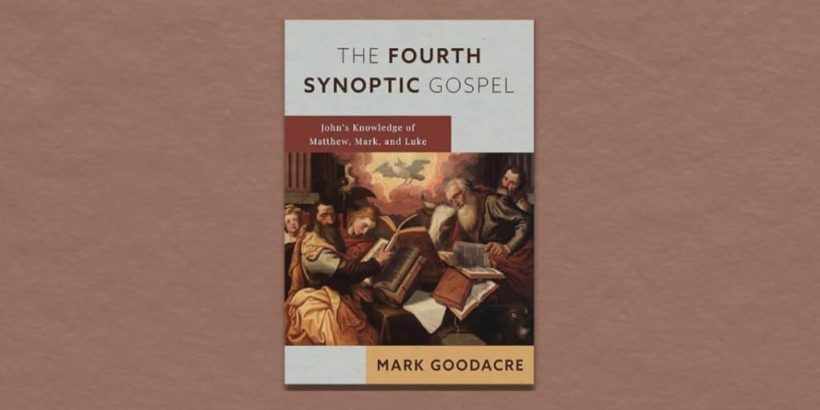
Goodacre, Mark
(2025) The Fourth Synoptic Gospel: John’s Knowledge of Matthew, Mark, and Luke, William B. Eerdmans, Grand Rapids
This stimulating book has arrived just as I have been working on a podcast series on the reading of the Bible. Goodacre’s thesis is that the gospel of St John is indebted to the Synoptic Gospels. When B.H. Streeter wrote The Four Gospels, he was able to assert: “That John was familiar with the first three Gospels was taken for granted by the early Fathers, and was until recently assumed as axiomatic by modern critics.” (395) Ehrman, in the fifth edition of his The New Testament, circumspectly states that: “… many scholars continue to be persuaded that he (John) did not utilize the Synoptics.” A little later he writes: “… John does not appear to have used the Synoptic Gospels as sources.” (185) Goodacre is challenging this.
The Fourth Synoptic Gospel is a manageable volume of 165 pages plus bibliography and indices. There is a preface, seven chapters, and a conclusion. The preface states, with admirable conciseness: “This book … argues that the author of John’s Gospel knew, used, presupposed, and transformed the Synoptics.” (ix) Here, with one glance, we see the parameters of this study: Goodacre is pursuing only the thesis that St John’s Gospel can fairly be considered to be a “fourth Synoptic,” as the title proclaims; but also, he is not asserting that St John the Apostle wrote it, and he says nothing here about its dating. In fact, taking his thesis as a whole, he rather undercuts the historicity of the Gospel, because he consistently treats St John (whom I accept as the evangelist) as developing the picture of Our Lord, His words and actions, by creatively expanding on the Synoptics. As we shall see in future instalments, it does not seem to occur to Goodacre that St John may have elaborated on them by reference to what he remembered Our Lord to have said and done.
First, the conclusion. This is given in little more than two pages. Once more, I must commend Goodacre for his precise and economical writing. He says that the reader of the gospel will naturally have read the three Synoptics, and understand St John’s gospel in terms of those. Today, however, we – and by this he means academic scholars in what I call the “Bible studies establishment” –overstate John’s differences from the Synoptics. However, there are similar words and phrases, parallel passages, similar sequencing, and structure, with the motif: “the story of a hidden Messiah who is properly understood only by insiders, and only retrospectively after the experience of the resurrection.” (161) Goodacre has also demonstrated that St John wrote his gospel in such a way that he himself assumed his audience had already read the Synoptics (161-162).
Goodacre concludes that the similarities with the gospel of Saint Mark are quite significant, in structure, conception and sometimes in details; but it also has good connections with Matthew and Luke in their reinterpretation of Mark. On the hypothesis that the Gospel of St Mark was the earliest, he provides five examples of where Ss Matthew and Luke each reshaped Mark’s Gospel, and what is more, St John followed them. If this is so, then we can entirely dispense with the idea that St John was writing for a specific Christian community isolated from the others. On the “community” thesis, each gospel was produced within and for a different community; but if the evangelist assumes his audience has read the other Gospels, then – even on that view – he must be writing for all Christians. (162)
By reading St John’s Gospel as self-consciously with the tradition of the other three, then the beloved disciple is seen at once to be St John the apostle. (162)
Goodacre also makes an interesting point concerning the so-called “Johannine thunderbolt” in Mathew and Luke (“All things have been handed over to me by my Father, and no one knows the Son except the Father, and no one knows the Father except the Son and anyone to whom the Son chooses to reveal him.” Matthew 11:27, paralleled in Luke 10:22). This passage is strikingly similar to the ideas expressed to greater length in the gospel of St John, and is evidence not of some strange anomaly, but that the theology of John is in continuity with that expressed in those gospels. (162-163)
St John’s declared reason for the composition of his Gospel (John 20:31-32) is likewise “deeply embedded in the Synoptic Gospels …” with the result that “The Fourth Gospel might begin with the Johannine Word made flesh, but it ends by bringing us back to Jesus, Mark’s Messiah, the Synoptic Son of God.” (163)
In future posts, I shall explore more of this valuable book. However, I reiterate that I do not agree with all of his conclusions and in particular, his presuppositions about the dating and authorship of the Gospel. In particular, I will suggest that we have at least two unaddressed issues in New Testament studies: first, that we simply do not have enough early gospel texts to be able to come up with a satisfactory hypothesis about their development. For example, it seems quite possible to me that, assuming the Gospel of Saint Mark was written first, Matthew and Luke as we have them now may have been formed in dialogue, as it were, one with the other, so that it is not a question of whether Luke had Matthew, or Matthew had Luke, but it is quite possible that both influenced each other for a period of time until they took their known shape. The second major issue is the fact that our Lord himself did not write the gospel or anything of a doctrinal nature. I would suggest that the early church was aware of this and that the gospel could only ever be approximate, and for that reason, they were prepared and even willing to have multiple perspectives in their sacred scripture, embracing the inconsistencies and even contradictions as an inevitable part of the tradition.
But there is a great value in this book: it shows both the weakness of the Bible studies establishment, and the hope of rational correction.
To be continued …
In the previous post reviewing this book, I shared out the main conclusions. Now let us look at some of the arguments in a little more detail.
In the first chapter, titled “First Impressions,” Goodacre commences with the traditional view that St John had knowledge of the Synoptics when he composed his Gospel; but then this started to change, so that academics considered Matthew, Luke and John to be independent of one another, the hypothesised Q document to be independent of Mark, and the Gospel of Thomas, when that was discovered, to be independent of all. (1-2) However, many have appealed to an oral tradition to explain similarities between Gospels, and as Goodacre notes, this strategy has the advantages of explaining any parallel, and providing early evidence of the historical Jesus (5). But an oral tradition is not a tangible body of material, “anything can be projected onto it.” If John appears to quote the Synoptics this can be referred instead to the oral tradition, and an absence of agreement, likewise, can point to the oral tradition (14). Only on two occasions do the evangelists refer to oral traditions – Matthew 28 on the story about Jesus’ resurrection, and John 21 on the supposed immortality of the beloved disciple – in both cases the oral tradition is debunked; and this shows that the evangelists could treat the oral tradition with caution (6). I would add to this, that these passages show that Matthew and John were writing while the oral tradition was current. Today, there is none – we have only the texts.
Then Goodacre turns to the belief that John has few if any close agreements with the Synoptics. Examining the healing of the paralytic in Mark 2 with that in John 5, there are remarkable points of contact, including the use of the word krabatton, which is lacking from Matthew 9 and Luke 5; while John does not have Jesus tell the man to return to his home (since he had been by the pool for 38 years), and has the man cured in very different circumstances. I would add this is an example, it seems to me, of St John correcting the Synoptic account. Goodacre sets out some other striking parallels between John and Mark which are not shared by Matthew and Luke. (8-11)
The next question is, if John had the Synoptics, how much agreement should we expect? Goodacre shows that when John quotes the LXX Old Testament, he paraphrases, and even when he refers to something twice, he varies his own terms. Goodacre calls this “internal quotation variation,” and offers three examples, in one of which Our Lord says to the Jews: “You are saying, ‘you blapsheme’, when in fact they implied but did not say that (John 10). We might expect similar variations should he use the Synoptics.
Further problems are that it is impossible to define how much similarity would be evidence of use of a literary source, and there is often an assumption that if one has a written source, one will include everything from it which would seem to us to be pertinent (15-16).
This leads to the important methodological point that one should not think in terms of John’s dependence on the Synoptics, because: “If John knows the Synoptics, he has reworked them, he has reimagined them, and he has transformed them” (17). Further, we should consider not only the details in which there are agreement or difference, but also the “deep conceptual parallels” (17).