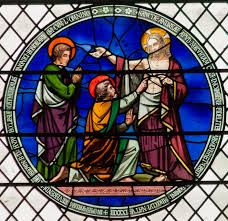
The tradition of the Church has, for some time and in many places, been to celebrate the Sunday immediately after Easter Sunday as “Thomas Sunday,” on which the Sunday’s Gospel reading was taken from the Gospel according to St John, chapter 20. It is known as “Thomas Sunday” not only in the Orthodox church, but even the Anglican. It is called “New Sunday” in the Catholic tradition, which may have to do with the renewal of Easter, and that many baptised on the Easter weekend were now “new” Christians. In my opinion, for what it is worth, we should retain it exactly as Thomas Sunday and as nothing else, because the fact that just this feast followed Easter illustrates and teaches a fundamental truth of the faith and human life: faith and doubt are never far from one another, but the road to falling is an easier one to take than the ascending path of faith.
That is, the very Sunday following Easter Sunday strengthens and gives human context to the triumph of Easter by reminding us that even while the glorious miracle of the Resurrection was fresh and new, a man who had been so close to the Lord as to be one of the Twelve Apostles, should nonetheless doubt, and that his doubt should be removed.
Doubt is ever-present. Doubt and scepticism are such intimate parts of our psychological lives that they appear to be native. Perhaps we can say that they are part of our human nature, meaning by that, part of our fallen human nature. We treat doubt as if it were a sin – and in certain circumstances it can be, for it can lead to a loss of faith, and even to despair. But doubt does not have to degenerate like that. It can be transformed by an encounter with the truth, if the heart and mind of the doubter are open. Doubt cannot be stamped out, as it were, but it can be answered. That is why I maintain that, all things being equal, it is better to engage with doubt than to attempt to quash it. If our children and friends doubt, then, to a point, one would be – I suggest – wise and charitable to ponder well how to deal with those doubts. Perhaps he who has these questions is perfectly sincere.
Very often doubt is a sign not of hatred of the faith, but of a person wanting more of the faith and wishing for it more fully and deeply, but wondering where it is, and if he cannot find it, does that mean that he is searching for a mirage? Too often, the reason children rebel against the faith is because those who preach it and are their role models are disappointing. They would appear to be evidence that the faith turns one into a preachy hypocrite with more than a dash of cruelty.
The story of St Thomas also reminds us of human weakness. We all share in this. And, in accordance with human nature, it reminds us also of the strength we can receive from God – for St Thomas was a major force in the spread of the faith. Perhaps it is better to say that he laid himself down so that the force of God could work through him. There are ancient legends that he travelled as far as India, and Indian Christians today still very often think of themselves as “St Thomas Christians.” Also, there was a significant body of writings attributed to him in the ancient world. He may not have been responsible for them, but this does show that he was highly esteemed. Once more, strength and weakness go together in our human experience.