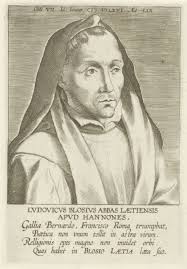
Blosius distinguished ordinary and extraordinary contemplation. These are different experiences, not different creatures, but the distinction is nonetheless useful. He said that “…ordinary contemplation means a close union with God in intellect and will, which is the result of faithful correspondence to the grace he bestows according to the ordinary laws of his providence in the supernatural life.”
This is a great thing. It is not to be despised, and it can, I believe, lead to the next step, extraordinary contemplation. Of that, Blosius wrote: “Extraordinary contemplation is a singular and miraculous union of mind with God, by simple intuition, accompanied with most ardent love, exceeding the ordinary laws of his providence in the supernatural life.”
Note the role of love: Blosius will return to this again and again, even if only by a word here or there. He continues: “From humility, we should not presume to ask for extraordinary contemplation than for the gift of miracles or prophecy.” But, he says, we can ask for ordinary contemplation, because the gift of contemplation increases charity.
Now of course the unity between man and God, even between the soul of man and God, can never be complete, but Blosius tries to indicate “the wonderful closeness of spiritual union between the purified soul and the infinite majesty of God in mystical contemplation.”
At this point, the editor of the volume found it necessary to note an error called Quietism, saying: “Amongst others things Molinos contended that the “interior life consists in annihilating the powers of the soul”; that is the memory, intellect and will. St Thomas, on the contrary, teaches that they should be employed in God’s service.” The Molinos referred to was a Spanish thinker who in his 1675 book The Spiritual Guide, said that we should make no personal effort at all, but rather allow God to do all (assuming that He will do so). The teachings were condemned in 1687. Now Blosius had died in 1566, long before Molinos and the Quietist controversy. But the editor is clarifying the position for us, in case we now should think that Louis de Blois (Blosius) was a Quietist.
It goes on: “The third and highest part of the soul, called the mind or the apex, that is, the highest summit of the spirit, is the simple and God-like basis or groundwork of the soul, that is, the simple essence of the soul sealed with the image of God. When considered in relation to this spiritual basis of the soul, life is called super-essential, [above the nature or constitution of a thing.] through which both the spiritual and active life are perfected. From the mind itself the three higher powers flow, and re-flow again into it, as rays of light emanate from the sun. Here, in truth, the likeness of God shines out in a wonderful way. For as the Father and the Son and the Holy Ghost are three Persons, but one God, so the memory, intellect and will are three powers, but one mind. And just as the three Persons of God work together in inseparable union, so do those three powers of the mind. The memory recalls nothing without the intellect and the will ; the intellect does not understand or know anything without the memory and the will ; and the will desires nothing without the intellect and the memory.
One consequence of this union is that the term ” mind ” is often used to denote the higher powers as well as the essential basis of the soul. Also, the term ” spirit ” is often employed when both the basis of the soul, as well as its powers, is meant ; as, for instance, when it is said that man is composed of spirit, soul and body. In this phraseology the human soul is divided only into two parts. Frequently, also, by the term ” spirit ” the whole soul is meant.
It goes on: “… remember that not only bad things, but even those that are good can become impediments if they are loved or sought inordinately, just as plates of gold before the eyes prevent sight as effectually as plates of iron.”
“When a man, for God’s sake, fights against and mortifies the indulgence of his own senses and his own self-will, even in the least things, he does a thing more pleasing to God than if he were to recall many dead men to life. Suppose that two men, walking the same way, both noticed a beautiful little flower; if one, though feeling inclined to pick it, should reflect within himself, and say : “I will leave it for God’s sake ” while the other, without thinking at all about the matter, simply followed his inclination and gathered it ; though it is quite true that the one who picked it committed no sin, yet the other who left the flower for God’s sake would obtain as much more merit as the heaven is raised above the earth.”
Now this is a remarkably strong statement, but it is worth pondering. What I think it may be getting at is this: there is no greater goal, no higher aim in life, than the love of God. That is our criterion for judging the value of anything, including the merit of our actions. If we have that fixed firmly in our minds, and yearn for that above all, we may begin to think the way Blosius did.
Finally, the picture of him which has come down to us is striking. He must have been quite remarkable; but not wonderful as his spiritual teaching.