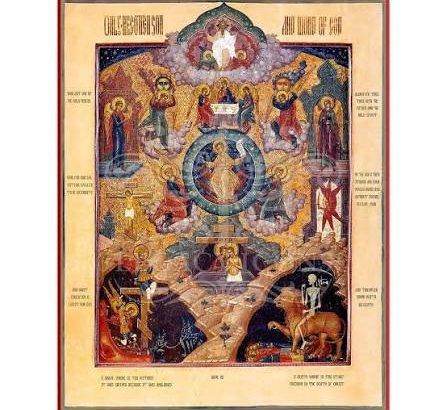
Maronite Meditation 92
I wish to examine the question of the “Only-Begotten Son of God,” from a Syriac perspective. As we know from the history of the Christological disputes, language differences can result in serious theological differences where, in reality, there may be more agreement than otherwise. I am going to suggest that there is an ambiguity in the English phrase the “Only-Begotten Son of the Father” to speak of Christ. Further, there is a richness in the Syriac concept of the yee.Hee.dō.yō which is not easily captured in English, Greek, or Latin. I am going to suggest that, just as there can only be one God, so too there can only be one yee.Hee.dō.yō.
I shall argue that this is because the Father expressed the whole of Himself in his Son, for the purpose of our salvation: not a part, not a section, not some features. There is and can be only one Son alone because the being, the entirety of theFather and Son are one; and whoever sees the Son with the eyes of faith sees also the Father.
But even more, no part of yee.Hee.dō.yō means “Son” or “begotten.” It means “unique,” or to be more precise, “uniquely united,” that is, uniquely united to the Father.
I have considered what Ss Augustine and Thomas Aquinas say about the Trinity, but I do not know that it covers quite the point I wish to make. So I shall have to proceed not by appeal to experts, but to etymology, the study of the history of words. And this, itself, is true to the Syriac tradition which was much less likely to quote older writers, but nonetheless being in continuity with them.
I begin with the Syriac because that is the closest surviving language to the Aramaic which the Lord and His Apostles used. The Syriac word in question is yee.Hee.dō.yō. According to Sokoloff, yee.Hee.dō.yō comes from the Syriac root, ܝܚܕ to be united (yaHed, in what is called the Pa’el form). It means “lone one, unique one” and is quoted as referring to Jesus. Then there are secondary meanings of solitary, individual, and separate. The root word has nothing to do with being born – all it means is, in my paraphrase, uniquely united.
But this meaning is not the first meaning of the other languages; hence the ambiguity in them. Let us commence with the English “Only-Begotten Son of the Father.” Those words make it sound as if God the Father produced one child and then stopped, almost implying that He could have had two or more, but did not; or that He could now decide to have another Son. This ambiguity was also inherent in the original meaning of the word monogenēs in ancient Greek. It is also used that way, sometimes, in the New Testament (see Hebrews 11:17 where Isaac is described as the monogenēs of Abraham; and Luke 7:12; 8:42 and 9:38 where the dead children who were raised were each described as monogenēs). In those cases, I suggest, the meaning of the word is that they were the sole children. The Greek root monos means “sole,” and the root “gen-” is connected with ideas of birth.
But the same word is used for Christ in St John’s Gospel because the Greek word monogenēs has two broad meanings: first, “to being the only one of its kind within a specific relationship;” and second, “to being the only one of its class, unique …”
In both Syriac and Greek, the terms in question, yee.Hee.dō.yō and monogenēs can be used to refer to the situation where a father has but one child. That is an open interpretation. But the more usual meaning, and the one which the dictionaries apply to the Son of God, is the meaning of “the only one of its kind.” That is, not only that God had only one Son, but that there only ever could be one.
Only in the Syriac, I would say, is the original meaning of this adjective uniquely united, and no notion of birth is implicit, although it could be used for an only child. In the other languages, being the only child or only example of a class is the dominant concept.
Then, in St Matthew’s Gospel, it is said “blessed are the peacemakers for they shall be called sons of God,” the word used is huios. This is also the word St Paul uses in Romans 8:14, 15 and Galatians 3:26 and 4:6-7. But in Romans 8:16 and 17 St Paul uses the word teknon, which is a generic word for children. That is the word which St John uses for believers. He reserves the word for son, huios, to Our Lord Himself. He does so in both the Gospel and in his first Epistle – further strong reason for seeing St John as the author of both.
The point of all this is that St John is clearly being very careful about his vocabulary. Only St John describes the Lord as the monogenēs of God. Using the ESV translation, in John 1:14 we read: “And the Word became flesh and dwelt among us, and we have seen his glory, glory as of the only Son from the Father, full of grace and truth.” It is expressly indicated here that the monogenēs is full of the grace and truth of the Father. The role of the monogenēs is expressed in verses 14 and 18: He makes God the Father known: the Father is way beyond us, but the Son has come among us. Chapter 3 and 1 John applies these ideas to salvation: the Son brings eternal life to us.
To conclude: Christ expresses the fulness of the Father in this world to we mortal men. The Father begot one Son alone, completely sharing with Him His own Being, so that there could not be another Son. Could there have been two or more sons, then the divinity would be split in two, or more. Were there multiple Sons, there would need to be something to distinguish one Son from the other. These “children of God” would be finite, bounded, limited in their essence – they would be like pagan gods.
The fact that Our Lord is the Only-Begotten Son of the Father means that in Him, and in all His actions and words, we see the entirety of the Father to the degree that it is possible for mortal man to do so. The yee.Hee.dō.yō is our pledge of the unity of the Son and the Father, unto eternal life and salvation.