Understanding Types and Typology
Let us invoke the Holy Spirit as we approach the mystery of creation: the divine design and plan for the universe and humanity. In the Semitic way of thinking, God created the universe according to patterns, or types in His mind. We can still read those types in His work. The first example of creation by type is in Genesis 1:26-27, “And He said: Let us make man to our image and likeness… And God created man to his own image: to the image of God He created him: male and female He created them.” The “image of likeness” of God are the pattern (type) by which we were created.
I have dealt more fully with typology in chapter 12 of An Introduction to the Maronite Faith, and also in an academic article on beauty. Typology is a theology and Biblical interpretation, a spirituality, a philosophy, and an ethics. Here, I present only the first, general principles.
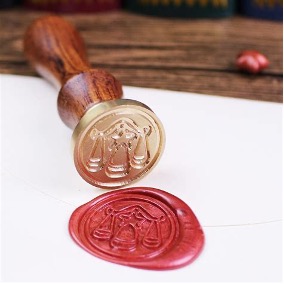
The three illustrations show what types and design according to type are. The picture above shows a seal and a piece of wax. The seal has three main elements: first, the wooden handle of the seal, by which it can be held and used; second, a metal head at the end of the handle; and third, a design on the bottom the metal head. The design on the metal head of the seal has been impressed on the wax blob, so that the image of the seal is also the image of the wax copy. With a seal, all I need to make copies is wax which is able to receive the impression of the seal, the energy to use the seal, and the skill to use it well. The Greek word for making an impression is the word from which we take our word “type.”
So, typology is the making of copies from an original type. The original type is also called the archetype. Sometimes the copy is called a type, and sometimes – especially in the First Epistle of St Peter – an antetype, meaning “what was opposite to the archetype.” The wax was opposite the archetype, which is why it can receive the imprint of the design. Because different terminology has been used in different places, I am trying to standardise the usage. Our use of the words has been a little chaotic, because people did not grasp the importance of typology, and have not returned to the roots to more precisely understand the words.