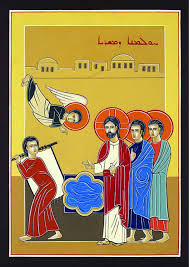
The icon of this week depicts the paralytic in the Gospel of St John, but – in good Maronite fashion – the Gospel reading and the liturgy are based on the paralytic in St Mark. The icon is entitled Hool.mo.no ed.mash.er.yo, the healing of the paralytic. The Syriac idea of paralysis is different from the Western: it is not rigidity but rather the lack of control which is central to our idea. The root of mash.er.yo is the verb shro, meaning “to loosen,” and for this participle, the meanings are “loose, dissolute, paralysed, paralytic” and the verbal form (Pa’el, for those who know Syriac) means both to relax and to paralyse. Here it is passive – the man’s ability to direct his limbs has been undone. This gives a deeper and more direct meaning to the Maronite hymn which says that all of us are like the paralytic man. How can that be, since most of us have the use of our limbs? Yes, we can use our limbs, but like him, we lack a certain power of self-determination, or ability to choose our own paths: it is our will which is paralysed.
The word we translate as “healing” does mean that, it also means “cure” and “recovery,” but the odd thing is that the root word means “dream.” There are other Syriac words for curing, but Hool.mo.no is the only one with a connection to dreaming. In modern Lebanese, a Hilm is a dream. In Arabic, the basic meaning is “dream” but it can also mean “gentleness, mildness,” or with different vocalisation, “maturing, puberty.” I think that the connection between dreaming and healing is more than simply the well-known connection between a deep restful sleep with a pleasant dream and feeling better the next day.
The entire Syriac tradition is unanimous that to dreams are a possible doorway to the divine. We cannot force our way into heaven by dreaming, but it can go the other way – the divine can appear to us through dreams, as we saw in the three dreams of St Joseph.
Also, there is a certain more-than-natural vision in dreams. The quality is varying. Sometimes dreams are clear as daylight, and at other times they are obscure, and can barely even be remembered. But they are seen, nonetheless, with a vision which is not physical. They therefore represent a journey into the other-worldly, and possibly into the spiritual. But what makes dreams different from other journeys is that there is always a return to the waking world, whereas one does not necessarily return from any other kind of trip.
This means, I suggest, that Hoolmono refers to a transition from one plane of life to another, and a return to our daily lives, but with the influence of the other level – and therefore recovered and healed; which distinguishes it from asee, the main Syriac word to heal or cure, because that word comes from words for “medicine” and “doctor.”
Let us now examine the icon. The skyline is the Holy City, Jerusalem. An angel descends to stir the waters of the pool. He flies in from the right hand side (from the Lord’s perspective.) The angel is swinging in like an acrobat on a trapeze: his head is on the same level as the Lord’s, and their haloes are close but not touching. The angel’s His feet are notably higher than his body which is bent backwards and downwards, showing that his feet are in heaven (whereas our feet are on the earth). He could not more clearly be a visitor from heaven.
The once paralytic man is walking away, as Our Lord had commanded, but his eyes are on Christ, and his bed has shrunk to the size of a flag over his shoulder, for he now has no need of the sick-bed, but his cure was done as a sign for us (recall that St John stressed how, at this stage of His ministry, the Lord had been working signs.).
Jesus is in the middle of the icon, slightly taller than John and James, and much taller than the cured paralytic. The Lord and His apostles form one group. The pool of Bethsaida is shown in the Ancient Egyptian fashion, as a standing pool of water – that is, we see it as we would if we were suspended over it in space. It hovers over the ground, suggesting that it is in sacred space. The angel looks at the pool, and points to it with one finger of his right hand. The ripples on its surface suggest that its waters are disturbed as if by a line of force coming from the angel’s hand.
Meanwhile, the Lord is looking directly at us, but pointing to the former paralytic with two fingers of his right hand, his hand being held above the pool which is itself already above the earthly level. Christ is also holding in his left hand the scroll of the Law. This shows that He Himself possesses authority and power greater than the force which is moving the pool or that in the Law. His gaze addresses us directly as if to say: “Behold, and let him with eyes to see understand!” The Lord wears white (purity and divinity) with a red cloak (His passion and sacred blood).
Behind the Lord stands St John, the writer of the Gospel whose right hand is pointing upwards – reminding us of how Leonardo da Vinci showed the hand of St Anne pointing the same way, in “The Virgin and Child with Ss Anne and John the Bpatist” in the National Gallery, London. It is a testimony to the presence of God among us, reminding us to make heaven our aim. But Ss John and James are looking at the miracle which has taken place. The blue folds of St John’s cloak mirror the swirling of the waters, a sign that the miracles of God were and are not limited to the waters of Bethsaida.
Finally, the Lord alone wears sandals – the other three have bare feet, for they are standing on sacred ground, but Our Lord Himself is the most sacred ground. Once more, it is almost astonishing how much material for meditation the late Fr Badwi has given us in this deceptively simple icon.