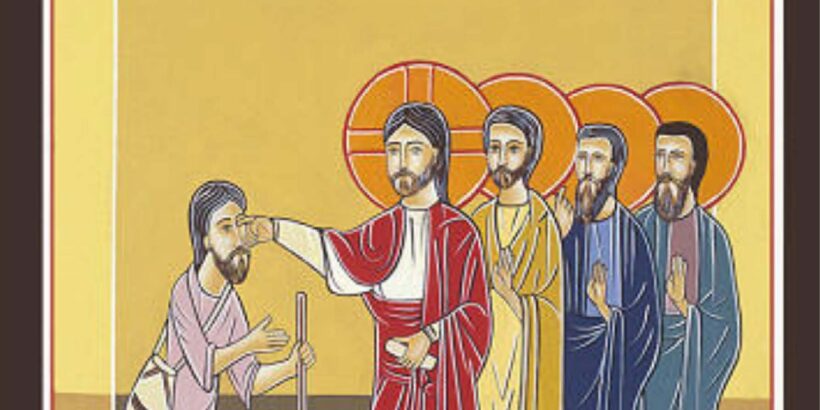
Once more, the icon is set against a Jerusalem sky-line. As we know that Our Lord was entering Jericho when this occurred, and Jericho is much lower than Jerusalem, then we must “see” Jerusalem as being high above. In the middle of the foreground is Christ. On our left is Bartimaeus (who has thrown off his cloak, and is walking towards the Lord), while to our right of the Lord are three apostles (Peter, James, and John).
The Lord is shown significantly taller than blind Bartimaeus, but roughly the same size as the three apostles who accompany him. However, He is distinguished by the halo around his head, not only larger than those of the apostles, but also filled with three arms of a Cross. The Lord wears white and red, for His purity (the garment) and His Passion (the red cloak). The three apostles hold up their left hands in wonder, while St James has the first finger of his right hand lifted heavenwards, indicating that he is witnessing something divine – something of heaven. (James also makes this gesture in the icon of the healing of the paralytic).
The Lord has sandals, none of the others do; and He bears the scroll of the Law in His left hand while with His left hand He is placing His finger so close to the man’s head that He is effectively placing His finger in the blind man’s left eye.
What can be the meaning of the Lord’s finger seeming to enter Bartimaeus’ head through his eye? This is what the Gospel of St Mark tells us:
And as he was leaving Jericho with his disciples and a great crowd, Bartimaeus, a blind beggar, the son of Timaeus, was sitting by the roadside. And when he heard that it was Jesus of Nazareth, he began to cry out and say, “Jesus, Son of David, have mercy on me!” And many rebuked him, telling him to be silent. But he cried out all the more, “Son of David, have mercy on me!” And Jesus stopped and said, “Call him.” And they called the blind man, saying to him, “Take heart. Get up; he is calling you.” And throwing off his cloak, he sprang up and came to Jesus. And Jesus said to him, “What do you want me to do for you?” And the blind man said to him, “Rabbi, let me recover my sight.” And Jesus said to him, “Go your way; your faith has made you well.” And immediately he recovered his sight and followed him on the way.
Two are things are occurring, I would suggest. First, the entry of the Lord’s finger into Bartimaeus’ eye shows that the faith the blind man is a faith in Jesus, and that as a result of it, the Lord has entered into him. Here this is shown by the finger, and the man’s right eye is open – showing that as Christ touches him, he can see. The second thing is that there is a conflation in the Syriac tradition. In John 9, the Lord cures a blind man by “anointing” the man’s eyes with a mixture of mud and saliva. Mark 7 a deaf man is cured when the Lord touches the tongue of a deaf man (placing His own saliva on the man’s tongue) and then his fingers in his ears.
The Syriac tradition is not only comfortable with reading all the Gospels together, it proceeds on the basis that this is the only right way to read them. This is not merely Fr Badwi’s approach: the originals of this icon in the Vatican and the British Library are identical in every respect except that there is no Jerusalem skyline, and the apostles’ hands are in slightly different positions.
These two matters are not separate. Why, in John 9 and Mark 7 does some of the Lord’s saliva touch the man being healed? I would suggest that the reason is that I have identified: some of the being of the Lord is being shared with the faithful. That it is His saliva may even be related to the Lord as the Word of God (both the Word and saliva issue from the mouth). Consider also the healing of the haemorrhaging woman: she touched the hem of the Lord and some of His power flowed into her. Both the saliva and the touching are symbolic of the Lord’s power.