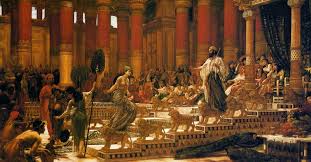
In order to read the Book of Ecclesiastes, also known as “Qohelet” with the mind of the ancient Syriac tradition, we must take the book as it presents itself, namely, as the work of Solomon. This was the ancient tradition. (Robert J. Wright, Proverbs, Ecclesiastes, Song of Solomon). Even if the use of the name “Solomon” was a literary device, and the king was not its true author, yet that literary device is part of the scriptural record, and the book is clearly intended to be read as if it were the writing of Solomon. In other words, the “authorship” of Solomon is an indication of how the book is to be read: as the authoritative record of the wisest of men, illumined by God, who had seen and tried all that the world had to offer, and knows whereof he speaks.
Ecclesiastes was accepted as part of Christian Scripture as early as Melito of Sardis in the second century. But more significantly, it was accepted by writers of the New Testament. Wright notes the following usages: in Ecclesiastes 1:2, we read: “Vanity of vanity, all is vanity,” and likewise in Romans 8:20, St Paul writes: “The creation was subjected to futility, not of its own will but by the will of him who subjected it in hope.” Then, Ecclesiastes 5:15, has: “As he came from his mother’s womb he shall go again, naked as he came, and shall take nothing for his toil that he may carry away in his hand.” This is echoed in 1 Timothy 6:7, where St Paul writes that we neither bring anything into the world nor take anything with us when we leave it.
In Ecclesiastes 7:20, we read: “Surely there is not a righteous man on earth who does good and never sins.” In Romans 3:10-12, the same thought is restated and developed a little. The very last line of Ecclesiastes, verse 12:14 reads: “For God will bring every deed into judgment, with every secret thing, whether good or evil.” 2 Corinthians 5:10 repeats this idea, stating, however, that we are bound to appear before the judgment seat of Christ. The fact that these four analogues are all found in one author, St Paul, is a powerful argument that he is not just restating familiar human truths, and by chance sounds like Solomon. One such similarity might be due to coincidence, but not four.
Also of some significance is that St Paul not only treats the Book of Ecclesiastes as authoritative, but also that he takes the consummation of that book – verse 12:14 – and applies it to Christ. Further, he takes the main motif of the book: that all under the sun is vanity of vanities, and modifies it in a crucial respect, saying that creation is vain “by the will of him who subjected it in hope.” Thus he shows that Ecclesiastes not only can but is to be read as a Christian book, meaning that all which we do is subject to the ultimate direction and judgment of Christ.
Yet further, St Paul shows us that Christians will read the book and its refrain of vanity as meaning that the intrinsic emptiness of the world is so by divine command and is subject to divine hope – therefore, we have no cause to despair.
Two more New Testament passages pick up the Book of Ecclesiastes. Verse 7:9 warns us not to be quick to anger, and the Epistle of St James 1:19 picks this up and expands it saying: “ let every person be quick to hear, slow to speak, slow to anger.” This is particularly interesting, as James 1:5 speaks about the need to learn wisdom, and in 1:17 he has written: “Every good gift and every perfect gift is from above, coming down from the Father of lights, with whom there is no variation or shadow due to change.” This is a clear indication of the basis of our hope, for the Father is not beneath the sun, as Ecclesiastes constantly reminds us of earthly life, but rather is above them: He it is who created them.
Finally in the New Testament, but by no means least, Christ Himself seems to allude to Ecclesiastes. In the Gospel of St John 3:8, He says: “The wind blows where it wishes, and you hear its sound, but you do not know where it comes from or where it goes. So it is with everyone who is born of the Spirit.” This would appear to be a development of the idea in Ecclesiastes 11:5: “As you do not know the way the spirit comes to the bones in the womb of a woman with child, so you do not know the work of God who makes everything.” Both are references to birth. Solomon has spoken of the spirit entering a child in its mother’s womb, and Christ spoke of the Holy Spirit giving spiritual life to us: compare this with John 1:12: “But to all who did receive him, who believed in his name, he gave the right to become children of God, who were born, not of blood nor of the will of the flesh nor of the will of man, but of God.”
This shows how close the thought of the Old and New Testaments can be, even in places where we least expect any connection. This continuous discovering of threads of meaning combining the two is, incidentally, another reason why the ancient and true tradition is to read the entire Bible as one whole.
However, one can also read the three books of Proverbs, Ecclesiastes, and the Canticle of Canticles, or Song of Songs, together. Saints Ambrose and Jerome developed a tradition from Origen, saying that Solomon had written these three books to guide each of three stages of the spiritual life. For beginners, Proverbs would teach how to live in the world; for serious students making progress, Ecclesiastes taught them to value eternity and to devalue the perishable world; and, finally, for the adept, the Canticle of Canticles was a mystical hymn of the love of God. This schema seems to have been adopted as a basis for teaching in some of the Western medieval schools, notably the Cistercian.
This is the traditional and best way to read the books: taking them on face value as the work of Solomon, who had an interest in wisdom, and collected sayings of the wise. It is also the key to the message of the books. Today we shall begin with Ecclesiastes, and its teaching that true and abiding goodness, truth, and beauty, belong to the life eternal, and not to the passing material world. The refrain of the entire book is “vanity of vanities, says the Preacher,” son of David, king in Jerusalem, everything that is done under the sun is vanity and striving for the wind.” The Preacher tries to imprint this on our minds that this life is limited and shall pass away. An equal part of his message is that we have a thirst for something permanent, and of abiding value. However, even while we are on this earth, we can seek God, and live by eternal values. To put it in a sentence, we can say that Solomon teaches us: “It is possible to live under the sun, remembering God.”