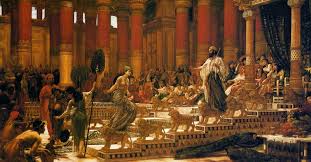
Let us turn to the first of the three books traditionally attributed to King Solomon, the Book of Proverbs. The very first verse declares: “The proverbs of Solomon, son of David, King of Israel.” His name is also found as that of the author at the start of chapters 10 and 25, while King Lemuel, Agur, and anonymous wise men are listed as compilers in other parts. Further, in the first Book of Kings it is said that he used 3,00o proverbs (4:32). Given that collections of proverbs were known as far back as in Ancient Sumer and Egypt, I can find no pressing reason to see those proverbs attributed to Solomon as being later than his time. Besides, the traditional approach is to give full faith to the Scripture itself, which states that most of the proverbs are from Solomon – which would mean either made or collected by him.
I am also going to suggest that in reading the three books of Solomon, Proverbs, Ecclesiastes, and the Song of Songs, we can and even should take them together, as mutually illuminating. They form a trilogy, like the three books of Lord of the Rings.
We will take one of the fundamental concepts in Proverbs, that of the “fear of the Lord.” Thus, at the beginning, we read: “The fear of the Lord is the beginning of knowledge; fools despise wisdom and instruction” (1:7). Why should fear of God be the first step to understanding? I shall suggest several reasons: briefly, this fear is based on an acknowledgement of the greatness of God and our humility before Him, and therefore accurately reflects reality, it gives us the correct perspective on the Creator and the creation which is a feature of knowledge, and it heightens our sense of responsibility knowing that we are going to be judged by a God who is all-knowing, all-powerful, all-good and all-loving; for the very fact of judgment points to a God who cares enough to take individual notice of us, to rate our accomplishments, and to restore justice to his suffering creation. Fear of God keeps us focussed on Him. It brings alignment to our feelings.
That will serve as an overview: let us now look more close at the fear of God. The Venerable Bede wrote that: “Servile fear is the beginning of wisdom because whoever begins to taste it after the error of sins is corrected by this first divine fear, lest he be led into torments. But perfect love casts this fear out.” (Wright) 7. There he is quoting the first epistle of St John (4:18). He continues: “Holy fear of the Lord then follows, remaining forever, and is augmented by charity, not removed by it. This is the fear with which the good son is afraid, lest he offend the eyes of his most loving father in the least degree. … But each fear will come to an end in the future life. Charity, however, never passes away, but will remain perpetually in the fulness of wisdom, which is to know the one, true God and Jesus Christ whom He has sent” (Wright 7).
This is a most insightful passage which, as we shall see, ties in with the traditional interpretation which we have already seen that when Solomon speaks it is Christ who is the tongue and mind with which he does so, and also, that these books of Wisdom are a sort of school, with lower, middle, and higher grades, so that what we learn today we may deepen tomorrow, and so on, until finally we come to the limit of our lives and the great day of judgment
So, “fear of God” in the Book of Proverbs does not necessarily mean terror, in fact, the words which are used in both Hebrew and Syriac can – most significantly – mean not only fear but also awe and reverence. I am not going to pretend there is no sense in which fear is meant, the apprehension of something which puts dread into us. That is an element. But what is foremost in these books is the fear which is united with the ideas of awe and reverence. The Venerable Bede has put it very well to say that it is like the fear of a good son who does not wish to hurt or offend his parents in any way. Because we know that God is truth itself, all-good, eminently desirable, and all loving, those acts which we perform out of reverent fear for Him will be acts ordered towards goodness, charity, peace, beauty, and harmony. If they are the opposite of this, they are not inspired by fear of God, but by negligence of Him. to be continued