Having looked at the nature of the Canticle of Canticles, let us work through its contents. It opens:
Let him kiss me with the kisses of his mouth! For your love is better than wine; your anointing oils are fragrant; your name is oil poured out; therefore virgins love you. Draw me after you; let us run. The king has brought me into his chambers.
The traditional interpretation, which I believe is correct, is that this is the soul speaking to Christ: the kisses of His mouth infuse us with the spirit of life. His love is His grace, and the anointing oils are those of baptism, chrismation, and Holy Orders. The virgins who love Christ are the souls which find the fulfilment of their yearning in Him; and He of course is the king. The chambers, naturally, are heaven. I do not say that the writer of the Canticle knew that this was its meaning. Rather, I would be surprised if he did. But this is why it is Scripture: it is a revelation, and it bears depths of meaning unknown to any one person, even the writer. Sometimes one acts and speaks without understanding the significance of what we have done and only later do we see that God has worked through us.
With that though, bear in mind that if we take all these images together, they make up a super-image. What is that super-image, and how do we perceive it? To be brief, the super-meaning is the beauty of God, and with that, the desirability of union with Him. We perceive it not through an idea reaching the ordinary mind or an emotion appearing in our feeling, but rather, with and over and beyond these, an impact is received, like a light going on in the soul.
Last week we saw how the other verses of Chapter One refer to the humility of the soul. In verse 11, it refers to the Divine Liturgy: “We will make for you ornaments of gold, studded with silver.” Again, gold and silver are part of the super-image. A little later, verse 15 can be interpreted either as the Church, the individual soul, Mary the Mother of God, or all three: “Behold, you are beautiful, my love; behold, you are beautiful; your eyes are doves.” Then it returns to this Divine Liturgy: “Behold, you are beautiful, my beloved, truly delightful. Our couch is green; the beams of our house are cedar; our rafters are pine.” This joy the soul feels should, ideally, be that of every Divine Liturgy. The eyes of a dove, the house naturally fragrant and long-lasting because made of cedar, the green couch and the rafters, again, all part of the mysterious super-image.
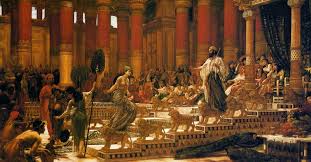
Chapter 2 opens with this remarkable line about the soul: “I am a rose of Sharon, a lily of the valleys.” This reminds us of Christ’s words in Luke 12: “Which of you by being anxious can add a single hour to his span of life? If then you are not able to do as small a thing as that, why are you anxious about the rest? Consider the lilies, how they grow: they neither toil nor spin, yet I tell you, even Solomon in all his glory was not arrayed like one of these.” This reference to Solomon indicates the possibility that Our Lord had the great Canticle in mind. Solomon and what was said of him in the Bible is likewise part of the super-image.
The soul sings: “As an apple tree among the trees of the forest, so is my beloved among the young men. With great delight I sat in his shadow, and his fruit was sweet to my taste.” (2:3) As we shall see in a future episode, this is the sort of verse which St John of the Cross understood and used in his mystic poetry. Obviously, no one can find much shade if they sit in the shadow of someone else, but the soul can receive the divine influence, and this remains, not only as if the oppressive heat of the day was being screened by the boughs of a tree, but more, as if one lives – for a time – in a different atmosphere, a different climate, we might even say in a different world.
The next part of this chapter not only provides further mystical poetry of the highest degree, but only a little thought will show that it cannot be literal:
He brought me to the banqueting house, and his banner over me was love. Sustain me with raisins; refresh me with apples, for I am sick with love. His left hand is under my head, and his right hand embraces me! I adjure you, O daughters of Jerusalem, by the gazelles or the does of the field, that you not stir up or awaken love until it pleases.
How the interpretation that it is a secular love song make sense of this: why, for example, adjure anyone, let alone women of the city, in the name of animals of the field? I would suggest that the love of the soul for God is seen as being a part of the natural order of the universe. Even the feeding of the soul is simplicity itself, and yet, these words “Sustain me with raisins; refresh me with apples, for I am sick with love” have an impact which we define or explain.
There is an interesting variation which older Catholic texts adopted: for verse 4 they read: “He set in order charity in me.” This was beloved of the patristic commentators, for example, St John Cassian wrote: “There is a properly ordered love that, while harming no one, loves certain persons more by reason of their good qualities. Although it loves everyone in a general way, nonetheless it makes an exception for itself of those whom it should embrace with a particular affection”
At the end of chapter 2 are these remarkable lines: “My beloved is mine, and I am his; he grazes among the lilies. Until the day breathes and the shadows flee. Turn, my beloved, be like a gazelle or a young stag on cleft mountains.” Here Christ is shown as patiently passing the night, grazing on lilies – of all things – until the day dawns. This is order in love – to see that the love of and for Christ is the greatest possible.