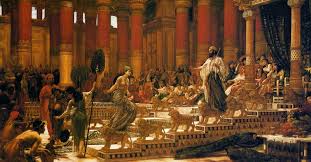
The Book of Wisdom, also known as The Wisdom of Solomon has been a very influential piece of Scripture: for example, it is often quoted by St Therese of Lisieux. However, although it was accepted as scriptural in early Christianity, Luther rejected it, and has been followed by up to all Protestants. But to appreciate how deep its teaching is, and how it was preparing the way for Christianity, just consider verse 1:7: “the Spirit of the Lord has filled the world.” You could take the entire book as an unfolding of this sublime teaching. This is why although it was probably written in either the first century B.C. or by the year 41 A.D. (for reasons which I will not go into) it was considered canonical. Hence, St Augustine wrote:
… two books, one called Wisdom and the other Ecclesiasticus, are ascribed to Solomon from a certain resemblance of style, but the most likely opinion is that they were written by Jesus the son of Sirach. Still they are to be reckoned among the prophetical books, since they have attained recognition as being authoritative. (On Christian Doctrine, 2.13)
Let us plunge straight into it, as it is one of those scriptures few people today know. In the RSV translation, the first fifteen verses read thus:
Love righteousness, you rulers of the earth, think of the Lord with uprightness, and seek him with sincerity of heart; because he is found by those who do not put him to the test, and manifests himself to those who do not distrust him. For perverse thoughts separate men from God, and when his power is tested, it convicts the foolish; because wisdom will not enter a deceitful soul, nor dwell in a body enslaved to sin. For a holy and disciplined spirit will flee from deceit, and will rise and depart from foolish thoughts, and will be ashamed at the approach of unrighteousness.
For wisdom is a kindly spirit and will not free a blasphemer from the guilt of his words; because God is witness of his inmost feelings, and a true observer of his heart, and a hearer of his tongue. Because the Spirit of the Lord has filled the world, and that which holds all things together knows what is said; therefore no one who utters unrighteous things will escape notice, and justice, when it punishes, will not pass him by. For inquiry will be made into the counsels of an ungodly man, and a report of his words will come to the Lord, to convict him of his lawless deeds; because a jealous ear hears all things, and the sound of murmurings does not go unheard. Beware then of useless murmuring, and keep your tongue from slander; because no secret word is without result, and a lying mouth destroys the soul.
Do not invite death by the error of your life, nor bring on destruction by the works of your hands; because God did not make death, and he does not delight in the death of the living. For he created all things that they might exist, and the generative forces of the world are wholesome, and there is no destructive poison in them; and the dominion of Hades is not on earth. For righteousness is immortal.
The theme of justice is mentioned first here, and is a sign that this is the main theme of the book, for justice can be considered as the values of God being manifested in the world. This demand for justice in action is directed to the princes of the world, for they set the tone for all others, and dispense justice in the courts and laws of the land. It tells them to look to the Lord, and to trust Him, for disbelief and distrust will separate us from God.
So too, it tells us, do perverse thoughts divide us from Him, and “wisdom will not enter a deceitful soul, nor dwell in a body enslaved to sin” or when one lives in unrighteousness. This is quite a deep thought: it is sometimes said that wisdom is simply the right or fit application of knowledge, but I think it is more than that. After all, if I correctly apply a new fitting to a hose, I am using my knowledge rightly, but that is not wisdom, or if it is, it is a very low form of it.
Wisdom, I have proposed, can be thought of “the natural operation and guidance of the godly soul in this world. … an interface between the divine plan for humanity, and the human faculties of reason and judgment. … (While) wisdom includes and employs our knowledge. Wisdom is the work of a higher mind: so high that the distinction between intellect and feeling disappears.” This being so, Wisdom will naturally recognise and be in harmony with all of the virtues, including not only faith, hope, and love, but also justice.
Hence the Book of Wisdom tells us that “wisdom is a kindly spirit,” and yet, because it is also a just virtue, it holds us responsible for “the guilt of (our) words.” This must be so, because otherwise, we could be irresponsible, and this is contrary to the free will God has given us, for free will presupposes responsibility. Further, this book states, God is the witness of our inmost feelings, and the Spirit of the Lord fills the world, holds everything together, and knows what is said. With our free will comes responsibility, and with being a part of the whole of Creation comes a responsibility to the whole: whatever we do is known by God because it affects the whole. Note also the teaching of the Spirit. As the Incarnation of Christ came closer, God was revealing more about His Holy Spirit.
This Book is worthy of the Epistle of St James, when it teaches: “Beware then of useless murmuring, and keep your tongue from slander; because no secret word is without result, and a lying mouth destroys the soul.”
To be continued