We return to chapter 3 of the Book of Wisdom, where we read in verse 9: “They that put their trust in him shall understand the truth: and such as be faithful in love shall abide with him: for grace and mercy is to his saints, and he hath care for his elect.” It would be easy to rush past this: first, it is saying that trust in God allows us to understand the truth. I suggest that this must be the case because our minds cannot, without his help, reach to the highest realms of the truth. I would put it this way: there are certain things within our purview of which we can learn something accurate. So if we study the circulation of the blood, or the growth of mosses, or the formation of geological strata, we can know a good deal of the truth about them.
But these are outside of us, and are of a lower order of life: one is inanimate, the next concerns plant life, and the third, the human body. When it comes to our spiritual faculties and the soul, it is impossible for us to look at them from a distance. That is, blood circulation, moss, and geology are objects to us, while our soul is us: it is no object, it is us as subject. Because we are outside ferns and flowers and we can say far more about them more accurately. But we are not outside either our souls or our minds. This limits what we can understand of them.
This is why we must put our trust in God to learn the truth about our soul: for example, how could we know that the soul is immortal unless God told us? Or how could we know the path to salvation and what will lead to damnation unless it is revealed?
Then, we are told that “such as be faithful in love shall abide with him,” which seems to suggest that the nature of love is such that it brings us closer to God: I think that is quite possible. Love is, as we have said, a uniting power. Since love comes from God, and it has that power of bringing hearts and souls together, it seems right and reasonable that those who love God faithfully will dwell with Him in eternity.
In verse 11 we see the sort of problematic statement which we have seen before; it says: “…whoso despiseth wisdom and nurture, he is miserable, and their hope is vain, their labours unfruitful, and their works unprofitable.” The fact of the matter is that this is not always what we see. It can be upheld only on the basis that this would come true, in some spiritual way, most likely in the next world. Then, in chapters 4 and 5, there is an extended and intriguing passage which explains the early death of some good people in an unusual way. These are some of the pertinent verses: “Yea speedily was he taken away, lest that wickedness should alter his understanding, or deceit beguile his soul. … He, being made perfect in a short time, fulfilled a long time. … Thus the righteous that is dead shall condemn the ungodly which are living; and youth that is soon perfected the many years and old age of the unrighteous.” (4:11, 13, 16) This is more reasonable than may at first appear: we see people who are sent sufferings and sickness for the better change of their hearts. Why then, should a good person not be taken back to God before the worse change of their hearts?
To the end of chapter 5, the main burden of the Book of Wisdom has been the unfolding of the teaching that the Holy Spirit fills the world, and so justice is enjoined upon all people. Chapter 6 sees another appeal to the princes of the world: “Give ear, ye that rule the people, and glory in the multitude of nations. For power is given you of the Lord, and sovereignty from the Highest, who shall try your works, and search out your counsels.” (6:2-3) As kings, they are told, they shall be judged quite strictly and will be rewarded or punished in the same measure as they have acted justly.
Also in chapter 6, the personified Lady Wisdom is presented as she had been in the Book of Proverbs:
Wisdom is glorious, and never fades away: yea, she is easily seen of them that love her, and found of such as seek her. … Whoso seeks her early shall have no great travail: for he shall find her sitting at his doors. To think therefore upon her is perfection of wisdom: and whoso watches for her shall quickly be without care. For she goeth about seeking such as are worthy of her, shows herself favourably unto them in the ways, and meets them in every thought. For the very true beginning of her is the desire of discipline; and the care of discipline is love; And love is the keeping of her laws; and the giving heed unto her laws is the assurance of incorruption … (6:12, 14-18)
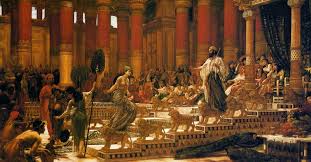
Then, the Book of Wisdom declares that it will teach us what Wisdom is, and her origin. It says: “I will tell you, and will not hide mysteries from you: but will seek her out from the beginning of her nativity …” (6:22) Before coming to this, he declares that he himself is a man, referring to himself as a king who prayed for understanding, so prompting us to identify him as King Solomon, who has a celebrated prayer for understanding in 1 Kings 3. Although he is only human, when God answered his prayer for wisdom, he was given “certain knowledge of the things that are, namely, to know how the world was made, and the operation of the elements. The beginning, ending, and midst of the times: the alterations of the turning of the sun, and the change of seasons. … And all such things as are either secret or manifest, them I know.” (7:17-18, 21)
To be continued