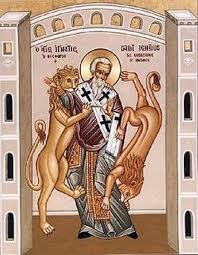
Ignatius, who refers to himself as “the bishop of Syria” (Romans 2.2), was important in the Maronite tradition: his letters were retained and studied, and an Anaphora of St Ignatius remains, although it has not yet been translated out of Syriac. Our sources for Ignatius of Antioch are twofold: his own correspondence, and what we are told of him by the patristic tradition. Outside of this, everything is indirect, or a question of our interpretation of the sources. First of all, let us consider the external evidence.
The best source is, once more, Eusebius in his Ecclesiastical History. In Book 3, he speaks of the succession to the throne of the Emperor Trajan, saying:
At this time Clement was still governing the Romans, and he also occupied the third place in the list of bishops in Rome after Paul and Peter; Linus was the first and after him Anencletus. Moreover, at the time mentioned, Ignatius was famous as the second bishop at Antioch where Evodius had been the first. Likewise, at this time, Symeon was second after the brother of the Saviour to hold the ministry of the church in Jerusalem.
This could be understood as not counting St Peter as the first bishop of Antioch, more as a sort of Pope. Taking all the late statements together, the narrative which was later accepted as true, had Evodius as bishop of Antioch for 29 years from about 41 to 70, or 45 to 75. There is one statement, based on a lost text of Eusebius, that Ignatius became bishop in 68. Trajan ruled from 98 to 117, so Ignatius must have been bishop from before the year 98, and until his death; but Eusebius does not say when he was installed. Even the sceptical Downey thinks it likely that he was bishop by the year 83. Eusebius states:
At this time there flourished in Asia Polycarp, the companion of the Apostles, who had been appointed to the bishopric of the church in Smyrna by the eyewitnesses and ministers of the Lord. Distinguished men at the same time were Papias, who was himself bishop of the diocese of Hierapolis, and Ignatius, still a name of note to most men, the second after Peter to succeed to the bishopric of Antioch. The story goes that he was sent from Syria to Rome to be eaten by beasts in testimony to Christ. He was take through Asia under most careful guard, and strengthened by his speech and exhortation the diocese of each city in which he stayed.
It is not known exactly why Ignatius was sentenced to death, except that he clearly believed that his execution would be a witness to his faith; and he would have known. It is believed that his condemnation occurred after an earthquake which shook Antioch on 13 December 115, while Trajan was in the city. It has been suggested in some modern writers that the earthquake was blamed on the Christians, however, I examined all the ancient evidence, and could find no warrant for this assertion at all. Some of the ancient evidence suggests that Ignatius was martyred in 107 or 108, while other puts it in 116. The date is believed to have been 20 December, of whichever year.
I am not going to enter into the controversy about whether any or all of the letters are inauthentic. The evidence for the authenticity of the seven letters is beyond cavil. That Ignatius did write some letters is clear from Polycarp’s statement that he would send what must be copies of them to the Christians of Philippi (Letter to the Philippians 13.2).
This is all we really know of him apart from his letters. Eusebius quotes those epistles, saying along the way, that Ignatius wrote seven letters while on this fateful journey. He mentions Ignatius’ letters to the Ephesians, Magnesians, Trallians, Romans, Philadelphians, Smyrnaeans and Polycarp. So we are informed that Ignatius was martyred in Rome, and little else. Origen, in his Homilies on Luke, tells us a little more, when referring to Ignatius’ letter to the Ephesians: “I found an elegant statement in the letter of a martyr – I mean Ignatius, the second bishop of Antioch after Peter. During a persecution, he fought against wild animals at Rome.”
I shall only superficially touch upon the seven authentic letters of Ignatius of Antioch, which are those to (1) the Ephesians, written from Smyrna (Eph. 21.1); (2) the Magnesians, written from Smyrna (Mag. 15.1); (3) the Trallians, written from Smyrna (Trall. 12.1); (4) the Romans, written from Smyrna and sent with some Ephesians (Rom. 10.1); (5) the Philadelphians, written from Troas (Phil. 11.2); (6) the Smyrnaeans (also spelled Smyrnaeans), written from Troas (Smyr. 11.2); and (7) to Polycarp, written from Troas (Poly. 8.1). Let us review them one by one. First, I shall give the opening of each, because something quite important emerges from being able to compare these, and then I shall look the Epistle to the Ephesians, and then some individual points from these epistles. First, the openings of the letters.
(1) The Ephesians. This epistle opens: “Ignatius, who is also called God-bearer (Theophoros), to the church that is blessed with greatness by the fullness of God the Father, a church foreordained from eternity past to obtain a constant glory which is enduring and unchanging, a church that has been unified and chosen in true suffering by the will of the Father and of Jesus Christ, our God …”
(2) The Magnesians: The opening words of this epistle remind one of the previous letter: “Ignatius, who is also called God-bearer, to the one that has been blessed by the gracious gift of God the Father in Christ Jesus our saviour, in whom I greet the church that is in Magnesia on the Meander and extend warmest greetings in God the Father and in Jesus Christ.”
(3) The Trallians. “Ignatius, who is also called God-bearer, to the holy church in Tralles of Asia, beloved of God, the Father of Jesus Christ, chosen and worthy of God [this refers to the church, not to Jesus], a church made at peace in flesh and spirit by the suffering of Jesus Christ, who is our hope for a resurrection that leads to him, a church which I also greet in fullness in the apostolic manner and to which I extend warmest greetings.”
Ignatius attacks the Docetists in this epistle when he insists: “… (Jesus) was truly crucified and died, while those in heaven and on earth, and under the earth looked on” (9.1). If Jesus only appeared to suffer, he rhetorically asks, then why am I suffering in reality” (10). It is easy to see why he condemns these people as atheists (atheoi) and unbelievers (apistoi) (10), it is because they have a totally false conception of God. The fact that there were such ideas militates against the notion that Jesus was simply a man who was later turned into a God, for, in the lifetime of people whose parents knew him, there were some who were teaching that He had been so divine His physical death was a mere illusion, a mirage.
(4) The Romans: “Ignatius, who is also called God-bearer, to the church that has obtained mercy by the greatness of the Father Most High and Jesus Christ his only Son; the church that is presiding in the land of the Romans, worthy of God, worthy of honour, worthy of blessing, worthy of praise, worthy of success, worthy of holiness, and preeminent in love, a church that keeps the law of Christ and bears the name of the Father …”
(5) The Philadelphians. The opening of this epistle is particularly interesting: “Ignatius, who is also called God-bearer, to the church of God the Father and the Lord Jesus Christ that is Philadelphia of Asia, that has received mercy and been founded in the harmony (homonoia) that comes from God, that rejoices without wavering in the suffering of our Lord and that is fully convinced by all mercy in his resurrection; this is the church that I greet by the blood of Jesus Christ, which is an eternal and enduring joy, especially if they are at one with the bishop (episkopos) and with the presbyters with him, and with the deacons who have been appointed in accordance with the mind of Jesus Christ – those who have been securely set in place by his Holy Spirit according to his own will.”
(6) The Smyrnaeans. Ignatius opens this epistle: “Ignatius, who is also called God-bearer, to the church of God the Father and the beloved Jesus Christ which is in Smyrna of Asia, which has been shown mercy in every gracious gift, filled with faith and love, and lacking no gracious gift, a church that is worthy of God and bears what is holy.”
(7) Polycarp. “Ignatius, who is also called God-bearer, to Polycarp, bishop of the church of the Smyrnaeans – rather, the one (i.e. Polycarp, not the church is the one) who has God the father and the Lord Jesus Christ as his bishop – warmest greetings.”
If one compares all these openings, the surprising thing is how uniform they are: Ignatius has an idea of what he wants to say with this opening, and he does not depart from it. The framework is like this:
- His name (Ignatius), his epithet (Theophoros).
- The church he is writing to as the church of God the Father.
- The divine abiding and supervision of Jesus Christ.
And through all of this, he manages to bring in two concepts, time and again: the gifts we are given through the grace of God, and the salvific suffering which we have been called to. Then, as a secondary issue, he mentions the ecclesiastical hierarchy in the epistle to the Philadelphians, and even a little in Polycarp. When you grasp this framework, you immediately understand the main contours of his thought. The man’s spirit and his methodical mind come through in this.
I offer some quotations from St Ignatius’ letter to Polycarp, using the translation of Kirsopp Lake. I shall link them together in a chain or catena:
Welcoming your godly mind which is fixed as if on immovable rock … I exhort you to press forward on your course, in the grace wherewith you are endued, and to exhort all men to gain salvation. … Be diligent with unceasing prayer. Entreat for wisdom greater than you have, be watchful and keep the spirit from slumbering. … The time calls on you to attain unto God, just as pilots require wind, and the storm-tossed sailor seeks a harbour. … The prize is immortality and eternal life. … Mark the seasons. Wait for him who is above seasons, timeless, invisible, who for our sakes became visible, who cannot be touched, who cannot suffer, who for our sakes accepted suffering, who in every way endured for our sakes.