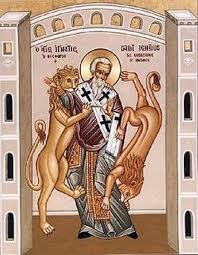
St Ignatius on Unity
Many deep theological themes can be found in Ignatius: he is a mystic, by which I mean that he develops concepts in a manner which is not irrational but goes beyond the intellectual. Central to all Christian mysticism is the yearning to be reunited with God. This unity can be understood as joining the Will of God, being absorbed in the Love of God, or losing myself in the beatific vision of God. This does not mean the annihilation of the individual soul: but it does mean that the sort of unity which is known in marriage, is found at a far higher level, and in a way we cannot understand, when the soul is finally “united” with God. The Orthodox call this theosis, becoming God, to the scandal of some non-Orthodox who take it too literally. What it means is this unity with God which, as it is His action, we cannot comprehend.
This search for oneness with God is, I believe, at the basis of all which St Ignatius wrote, for what is ONE in heaven, is MANY in this world; but the many do not have to be utterly separated from God. Rather, they can be brought into relation through a hierarchy, a holy rule or state of being. This is where the unity of the Church and its hierarchy comes in: the Church, bishops, priests and deacons mediate between the ONE and the MANY. They share in the characteristics of both.
For example, St Ignatius’s teaching on unity in Christ and harmony through the cosmos, takes concepts we know (e.g. unity among people on earth, and harmony among people), and refigures them in a cosmic and spiritual way, so that the unity and harmony we find manifested in the world are themselves reflections of and even participation in divine realities.
That, then, I suggest, is the key to understanding all which St Ignatius wrote. As I have said before, he is important for Maronite history because he was instrumental in setting the flavour, so to speak, for the Church in Antioch, and his writings were revered by Maronites. As I have mentioned, there is an Anaphora of St Ignatius in our old missals. He stands at the beginning of the development of Christian theology, and deals with many issues in the body of his letters. Let us take one, celibacy. Celibacy was highly valued, for Ignatius writes to Polycarp: “If anyone is able to honour the flesh of the Lord by maintaining a state of purity, let him do so without boasting” (Polycarp 5.2). To honour the Lord’s flesh by remaining celibate means that it was understood that He, in His flesh, had been celibate. That is, we honour what the Lord did in the flesh by imitating Him.
The paragraph as a whole also endorses marriage, but urges the groom and bride to be married with the consent of the bishop, so that “their marriage may be for the Lord and not for passion” (Polycarp 5.2). Robinson, referring to this paragraph, states: “Both marriage and celibacy were acceptable options in Ignatius’s church … Vows of marriage or of celibacy were to be carried out with the knowledge of the bishop, although marriage would have had a more public recognition; knowledge of a vow of celibacy was between the celibate and the bishop … there appears to have been a public recognition of celibate females (as virgins and widows).”
This provides an insight into the imitation of Christ. The celibate do so by directly imitating his celibacy, and the married do so by being joined as one in a ceremony before the Church, approved and witnessed by the bishop: the Church and the hierarch therefore mediating between the divine unity and the world. St Ignatius also imitates Him in a very special way, for as he says in chapter 4 of the letter to the Smyrnaeans: “… I am enduring all things that I may suffer with Him, and the perfect man himself gives me strength.”
Likewise, when he speaks to the Smyrnaeans about Burrhus, the messenger who is taking his epistle, Ignatius writes: “Would that all imitated him, for he is a pattern of the ministry of God.”
St Ignatius of Antioch is the earliest writer to refer to the catholic church, and to Christianity. These are, I have suggested, means of bringing us into a unity on earth so that we may enjoy a divine unity. In Smyrnaeans 8.2, Ignatius wrote: “Let the congregation be wherever the bishop is: just as wherever Jesus Christ is, there also is the universal church (hē katholikē ekklēsia). It is not permitted either to baptise or to hold a love feast without the bishop.”
That word which is in italics, katholikē, becomes in Latin, catholica. The roots of the word would literally suggest “throughout the whole”, and it is given in BDAG as “general, universal.” Then, Ignatius refers to Christianity, using the word Christianismos, in these passages:
- Magnesians 10.1, “… let us learn to live according to Christianity.”
- Magnesians 10.3, “It is outlandish to proclaim Jesus Christ and practice Judaism. For Christianity did not believe in Judaism, but Judaism in Christianity – in which every tongue that believes in God has been gathered together.”
- Philadelphians 6.1, “But of anyone should interpret Judaism to you, do not hear him. For it is better to hear Christianity from a man who is circumcised than Judaism from one who is uncircumcised.”
- Romans 3.3, “… Christianity is a manner of greatness when it is hated by the world.”
Although the word Christianismos was probably coined by analogy with the word Ioudaismos for “Judaism”, and Ignatius sometimes uses the two words in contradistinction from each other, he also sometimes speaks of Christianismos without comparison with Judaism,or paganism. In other words, for Ignatius, Christianity is an entity in its own right, and so it must have been for his audience. He also makes use of the word “Christian” (and not “Christianity”), although as that was not his innovation, all we need to note is that there are five occasions of this use in five letters, Ephesians 11.2, Magnesians 4.1, Philadelphians 8.2, Polycarp 7.3 and Romans 3.2.
But there is one small point: even if Ignatius did invent these two words, I doubt that he first used them in these letters. It might be too much to expect people to understand new words. I suggest that they were already in use in Antioch, and also throughout Christianity.
Burtchaell is doubtless correct to say that for Ignatius (also for Clement of Rome), “unity is God’s will for the churches, and that solidarity with officers is to be the instrument of that unity. … (and their targets) can only have been the charismatic apostles, prophets and teacher.” For Ignatius, respect for and unity with the threefold hierarchy of bishops, presbyters and deacons is so important that without them, one cannot even speak of a church (Trallians 3.1).
This unity is both manifested and furthered through the sacraments or Mysteries. There is an intriguing passage at Ephesians 5.2: “Let no one be deceived. Anyone who is not inside the sanctuary lacks the bread of God.” Now the Greek original reads: entos tou thusiastēriou, which is literally “within the altar”. The word thusiastērion is derived from the verb thuō which means “to sacrifice” and “to slaughter”. So the basic meaning of our noun is “a structure on which cultic observances are carried out, including esp. sacrifices, altar …”
What does it mean, then, to say that one must be “within the altar”? I would suggest that it refers to being with those people: the bishops, priests and deacons, who serve at the altar, i.e. who are in an area separate from the people. If I am correct, this would indicate that not only Ignatius but also his readers, and most especially the Ephesians, would understand that the church had what we now a call a “nave” for the laity, and an altar and space around it for the clergy. But some scholars have a different view. Thus, Isacson says: “thusiastērion does not refer to a physical altar but symbolically to the church gathered to worship. To remain “within the altar” is thus to take part in the worship (under the bishop).” In a footnote he adds: “The imagery favours this interpretation as does Ignatius’ use of thusiastērion in other letters (Mag. 7.2; Tr. 7.2 bis, Rm 2.2; Priesthood 4.1). There is no evidence from early Christian times that it refers to a physical altar.”
This is important: if early Christianity did not have any physical altars, then the Catholic and Orthodox understanding of the sacramental nature of early Christianity is quite wrong. At the very outset, I suggest that Isacson’s thesis does not seem likely: if the early Christians did not have physical altars, why did they use a word for sacrificial altars to refer to the Church? Would it not be surpassingly strange to refer to the Church by a term which had no bearing upon anything which it did? If their “worship” was unrelated to altars, why use “altar” as a term for that worship? What sort of worship does he think they partook in under the bishop? Let us examine the references which Isacson thinks support his argument.
First, the reference to Magnesians 7.2. There, Ignatius is telling the hearers not to remain in private, but to be united in “one prayer, one petition, one mind, one hope in love and in blameless joy, which is Jesus Christ. … You should all run together, as into one temple of God, as upon one altar (hōs epi hen thusiastērion), one Jesus Christ …” Here the use of the term hōs, “just as”, makes clear that it is a metaphor. This actually supports the idea that the altar he alludes to is a physical one, otherwise the image would have no meaning.
In Trallians 7.2, Ignatius is warning against heretics. He says that the one who is inside the altar (ho entos thusiastēriou) is pure, but he who is outside it is not. He then states what he means by that: “This means that the one who does anything apart from the bishop, the presbytery and the deacons is not pure in conscience.” In other words, it supports my reading of Ephesians 5:2: he is naming the clergy after the altar, and I cannot see that would make any sense whatsoever unless they were related to an altar somehow.
So we have, in St Ignatius of Antioch, a well-thought out, cohesive mystic doctrine, in which heaven and earth are brought into relation through the salvific actions of Christ, and the Church which He founded from eternity, and the hierarchy which celebrates the mysteries at the altar.
Downey states well how important Ignatius was, as bishop of Antioch: “… in (Ignatius’) day the Antiochene church appears before us as an entity emerging from a shadowy period, now in possession of certain definite and recognizable characteristics in doctrine and organization.” Taking this further by showing Ignatius fits into the history of Christianity in ancient Antioch, Wallace-Hadrill states: “We have the promises; we have sacraments; we have the examples of the saints and martyrs to encourage us; we have the Holy Spirit to teach us; but in the end we have our own will power, mutable and frail.”
There can be no guarantee of success hung like a label around the neck of the Christian. This is central to Antiochene thought, perhaps its most important single characteristic. It is first manifested in the anti-gnostic insistence upon the reality of Christ’s manhood in the letters of Ignatius, and reasserts itself constantly through the centuries to follow., reaching a peak in the controversy aroused by Nestorius and in the integrated theology wove around it by Theodore, and stretching far beyond the fourth century and far beyond the confines of the city of Antioch … It creates for itself an appropriate exegesis of Scripture in which the primary concern is to answer the question, “What, in the context of his own age, did the writer of this passage mean by it?” It attracts to itself the logical and scientific work of Aristotle and the later Platonists to provide itself with a suitable philosophic armoury. The human experience of Christ provides a point with which the struggling Christian can identify himself and which brings within the realm of human capability the daunting words, “Follow me”. The Antiochene quest of the historical Jesus was rather a function of religion than of antiquarian curiosity, the answer to the needs for a salvation which fits the facts of man’s condition and which does not sacrifice facts to the interests of neat abstract patterns. It kept its feet on the ground.
This is a good statement of the achievement of St Ignatius, but let us not forget that he was also a mystic, a profound theosophist, and a man who gladly went to his death, showing that he was no hypocrite, but really believed what he taught.