Before launching into these various episodes from Maronite history, it is desirable to point out that the basic fact of Maronite history, until about 1500 and even later, is that it is in darkness except for a few episodes where we have light. That is, Maronite history is not well-attested until modern times. No continuous history of the Maronites can be written, covering all developments and all major figures. We are bound to jump from one topic to another, and are unable to say anything about what happens “in-between”, as it were.
Maronite history is controversial. This controversy is partly due to the fact that there are so few sources for Maronite history for the period from its beginning up until the last two hundred years. For the very earliest periods, the few shreds of surviving evidence are often unclear, incomplete, and vigorously controverted. Although historians acknowledge that the sources are thin, they nonetheless try and fill them in as much as they can.
But even more than this, Maronite history is controversial because people try to interpret the past in accordance with how they wish to think of the future. They use history as a sort of gambit in a larger game of modern politics and ideology. In this course we shall try and be impartial, and not overstate the evidence in any direction or for any purpose. It is not possible to avoid all controversy, but I think we can avoid the practice of criticising others who offer conjectures, while doing the same ourselves. By far the most important book on early Maronite history is Peter El Khouri’s Aramaic Catholicism. My dependence on this volume will be apparent in every sentence of this essay. :et us commence with this 2018 article:
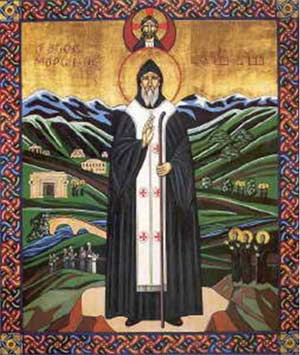
“Theodoret tells the story of Mar Maroun, a 4th/5th-century anchorite, who lived out of doors, ‘consecrating to God’ a former pagan sacred site near Cyrrhus in the province of Euphratensis and attracting numerous disciples. After Maroun’s death there was bitter competition to secure his relics; the successful village built a shrine and held a public festival for him (Religious History, 16; BHG 1172). John Chrysostom wrote to a ‘priest and monk’ called Maroun in 404/7 asking for prayers (ep. 36).”
“In the 5th and 6th centuries a monastery near Apamea named after Mar Maroun played a leading part in advocating the Christology of the Council of Chalcedon. A letter of 517 from the archimandrites of Apamea complains that Peter, the metropolitan bishop, and Severus, the Miaphysite Patriarch of Antioch (in office 511–18), had sent Isaurians to assault the monks (ACO III, 106–10; GT in Suermann, 79–81).”
“Like many Chalcedonians, the monks of Mar Maroun accepted the doctrine of Monotheletism promoted by the Emperor Heraclius as a compromise between Chalcedonian and Miaphysite positions. Monotheletism ascribes to Christ two Natures (human and divine), but only one will and energy. The Sixth Œcumenical Council (Constantinople, 680–1) condemned Monotheletism, but the Maronites were not present at the council and are not mentioned amongst the Monotheletes. From the 7th century onwards, they developed as a separate Church, whether because they were isolated from the Greek world by being under Arab rule or because as Chalcedonians they were distinct from their Miaphysite Syriac Orthodox neighbours. Certainly the Melkite Theodore Abu Qurra (d. c.820) describes the Maronites as distinct from both Miaphysites and Chalcedonians.”
“The increasingly independent Maronite community required dedicated church officials, as the Patriarch of Antioch resided in Constantinople from 636 onwards, and between 702 and 742 no Patriarch of Antioch was appointed at all. John Maroun (d. 707) was appointed the first Maronite patriarch. Dionysus of Tel Mahre (d. 845) is the earliest author to describe the Maronites as a separate community with a history going back to the late 6th century and headed in the 8th century by a patriarch, but he does not provide any details. The Maronites developed as a spiritual and military ‘nation’, settling in the Lebanese mountains for protection from Melkite and Miaphysite attack. Muslim persecutions in the 9th century forced the community to withdraw entirely, and the monastery at Apamea was destroyed in the 10th century (al-Mas‘udī d. 956). In the Crusader period the Maronites united themselves to the Church of Rome, eschewing Monotheletism but retaining their distinctive Syriac liturgy. Two features of Maronite history continue to be much debated, namely their early historical origins and their stance in the Christological debates of Late Antiquity.”
This is a very good summary, although more can be said about it, and I think some of it is over general. We now turn to St Maroun.
Ancient Cyr, also known as Cyrrhus and Kurros, in Syria was founded in about 300BC, and was named after the city of Kurros in Macedonia. It was in northern Syria, not far from Aleppo and the modern Turkish border. The bishop of Cyrrhus was present at the Council of Nicaea in 325. Theodoret was its bishop between about 423 and 458. We are almost totally reliant upon his History of the Monks of Syria. Theodoret is uneven in his treatment of the monks, and aimed to relate what he had seen of these monks for himself, or learned from those who had themselves met the relevant monk. Unfortunately for us, it appears that Theodoret did not ever meet St Maroun, and perhaps for this reason, commentators observe that Theodoret’s brief account is very thin for such an important monk.
St Maroun is an enigma. He is important in Christian history: no other Catholic rite is, so far as I know, exclusively named after one person, yet little is known of what he said and did which made him so important – except for the essential points. We shall begin with the only biography of him, chapter 16 of Theodoret’s writings on the holy hermits and monks of Syria. It reads:
1 After Akepsimas, I will call to mind Maroun, for he adorned the godly troop of the holy ones. Maroun embraced life under the sky, taking for himself a certain hill-top which had long ago been honoured by the impious. And having dedicated to God the sacred precincts of the demons in that place, he passed all of his time there, pitching a small tent, but making little use of it. Maroun did not only employ the customary labours, but he conceived others also, gathering together the wealth of wisdom.
2 The judge measured out grace for these labours: so richly did the munificent one grant to him the charism of healing, that Maroun’s fame ran about everywhere, and everyone from everywhere was attracted, so that experience taught them the truth of the report. It was seen that fevers were quenched by the dew of his blessing, shudderings ceased, and demons fled – many and varied sufferings were cured by the one remedy. For the race of physicians applies to each illness the corresponding medicine, but the prayer of the holy ones is the common antidote to all pathologies.
3 But Maroun healed more than bodily weaknesses alone: he also applied the bountiful cure for souls. He heals the greed of this man, and the anger of that man. For one man, Maroun proffers the teaching which leads to self-control, while for another man he bestows lessons in justice; he tempers the man of intemperance, and arouses the sluggish. Farming in this wise, Maroun cultivated many crops through his wisdom: it was he who planted the paradise which now blooms in the land of Kurros. The great Yakobos (James) was a product of this cultivation: of him and of all the others whom I shall recall individually with God’s help, one could rightly apply the famous prophetic saying: “The just man will flower like the palm tree, and will be multiplied like a cedar in the Lebanon.”
4 Caring in this way for the garden of God, doctoring to both souls and bodies alike, he patiently suffered but a short illness. Maroun, teaching us the frailty of our nature and strength in commitment, withdrew himself from this life.
Quarrelling broke out between the neighbours over his body, a violent quarrel. A populous bordering village came out in a body, scattered all of the others, and seized this most-desired treasure. They built a great sacred enclosure, and even to this very day they reap the profit, honouring Maroun the victory-bearer with a public feast. And even we, who are at a distance, reap his blessing, for it is not Maroun’s tomb which contents us, but his memory.
In addition, Theodoret mentions Maroun in some other places, translated by the author:
Chapter VI, Symeon (Not St Simon the Stylite)
(summary) 2 Some Jews were journeying to a citadel which lay outside of our “inhabited world” (oikoumene). They lost their way in a storm, and came upon Symeon in his cave. Symeon offered them guides to put them back on the right road, and summoned two lions, who at Symeon’s direction, led the Jewish travellers back onto their road.
3 “But no one is to think the narrative is fabulous, for I have as witnesses to its truth, those who are usually foes of the truth. Indeed, the very Jews who met with this good service continued to praise this act. And this was told to me by great Yakub himself, who stated that he had been present when the Jewish travellers related the miracle to the divinely-voiced Maroun.” [Theodoret then stresses that this was an instance where Jews witnessed a miracle wrought through a Christian.]
Chapter XXI, Yakub
(summary) Yakub had been a companion of Maroun, who had lived in a place once holy to the pagans, and protected himself from the elements only by retiring to a tent made of “hairy skins” in rain or snow.
Chapter XXII, Limnaios
2 Limnaios had been a pupil of Thalassios, and then went to Maroun at the same time as Yakub, and after this, being eager for the “life under the sky”, took possession of another hilltop, lying above the village of Targalla.
7 Dwellings for the blind were built near-by. Limnaios and James have completed their thirty-eighth year.
Ch. XXIV Zebinas
2 Zebinas was admired by Maroun, who advised all who visited him to obtain Zebinas’ blessing. Maroun wished to be buried in Zebinas’ grave.
Chapter 30 mentions Maroun only to say that Domnina emulated his life. Price states that St Maroun professed himself “the disciple of Zebinas”. However, this is not what the text says. Incidentally, as we have seen, “Zebinas” was also the name of a bishop of Antioch. It shows only that the name was not unique among Christians.
One thing I appreciated in your article is the insistence on restraint in the face of fragmentary sources. Reading Theodoret’s account of St Maroun, I was struck by how founder-centred the early Maronite story appears—more a circle of disciples gathered around a charismatic ascetic than a system with clearly articulated doctrine.
In that sense, the gaps in the record may be less anomalous than they seem: authority and continuity seem to have been transmitted primarily through persons rather than texts. Later Christological and institutional debates then appear as attempts to formalise and define a community that had already cohered around a lived spiritual lineage