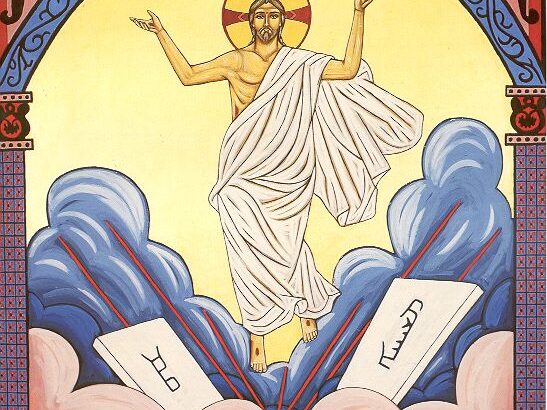
We have discussed the first word of the “Our Father”: in Syriac, Aboun.We saw that this has the clear implication that we are children of a common Father, and that a Father is different from a creator, because the Father shares his own being with His children. They are not just products rolling off an assembly line. This may be part of the meaning of Sacred Scripture when it teaches that God created us in His own image and likeness (Genesis 1:26-27 and 5:1). The very next line has sometimes struck people as puzzling because it seems to suggest that the Name of God is not, as matters stand right now, holy.
In Syriac, we pray: Aboun d.baš.ma.yo net.qa.daš šmōkh. Directly translated, this is: “Our Father in heaven, let your name be hallowed.” But what does this mean, that God’s Name be hallowed?
Having consulted Sokoloff’s Syriac dictionary, it seems to me that the most likely meaning of this line is: “may you who are in heaven show your name to be holy.” And the basic original sense of the root qadeš seems to have been “separated from what is earthly.” Further, it is beyond dispute that it is God who is being asked to sanctify His name, to show that it is holy, more than worldly. This is a familiar Semitic way of speaking: the passive can be used to indicate that God is the actor.
The original sense of the root qadeš seems to have been “separated,” in the context of separating what is divine from what is earthly or profane. The implication must be not just “different” but more so, “higher because belonging to God.” In the same way, the word “temple” probably comes from a root cognate with the Greek temnō, meaning “I cut off.” So the temple was that land and building cut off from what is profane for a special purpose, or in recognition of its special character.
These two examples indicate that the difference between the sacred and the profane is absolutely fundamental to the religious mind. We commence with the recognition of the greatness of God, and then we seek to bridge, as it were, the space between us by prayer. But of course the true bridge is Christ: God incarnated as Man.
Christ established a Church, a people called out from a vast number. The church perpetuate the sacraments and with them the priesthood. The priest is a mediator who celebrates the Holy Mysteries or Sacraments by which the receipt of divine grace upon the earth is guaranteed. The point is that a bridge connects two shores, and so we must begin with the recognition of the distance between heaven and earth. Why I would look for a bridge if I denied I had anything to cross?
So now we see that the fundamental sense of the opening of the “Our Father” is: “Our Father, may You who are in heaven show Your Name to be separate from and above all that is earthly.” In other words, we pray that Our Father in heaven may show us that His Name, His very essence, is not only different but transcendent to all which is earthly.
Since God’s Name is a way of referring to His very essence, then to “sanctify” His Name is to reveal Himself to us in His transcendent greatness. For God to hallow His Name is not to have good things said about Him, in some ordinary way, but rather to reveal Himself to us in His majesty.
We find a parallel thought in John 12:28 when Our Lord says: “Father, glorify thy name.” A voice therefore came from heaven: “I have both glorified it, and will glorify it again.” And you will remember, people did not know whether an angel had spoken, or whether they only heard thunder! Then, in St John’s Apocalypse, 14:2, he declares: “And I heard a voice from heaven like the roar of many waters and like the sound of loud thunder …”
The entire thrust of the opening of the prayer, then, is to affirm that there is a distance between heaven and earth which can be bridged in one way and in one way only: by an act of God. But there is something we can do nonetheless – we can appeal to God to do reach down from heaven by revealing Himself to us: to net.qa.daš, as it were, His Name. And that means, to show us what He showed the chosen apostles at the Transfiguration.
The extent to which we open this prayer by situating ourselves far below God, and Himself far above, cannot be overstated. But equally with this, the entire logic of the Our Father” is that prayer can reach God, and that He will respond. So, in the end, the great distance between heaven and earth, shows the greater goodness of God who has made us for, and brings us to, Himself.
It needs only a moment’s reflection to see that God’s name, that is, His very being, is already holy. We humans cannot make it more holy than it is; but if we cannot hallow His name, we can pray that He do so: that is, that He show His holiness and glory to us. Thus the fact that Our Father is said to be in heaven is critical to the meaning: we are asking that something at least of the transcendence of heaven be revealed to us. We are praying that we be allowed to see God in all His Majesty, to witness the Transfiguration of All.
Thus, we have opened by addressing our common father, whom we acknowledge to be in a world infinitely higher than this one. But we ask Him to incline towards us, to bridge the gap. This can be related to Psalm 40, “Patiently (or in hope), I waited upon the Lord. He inclined unto me, he heard my cry.”