Christ Himself is also the point of continuity between the Old and New Testaments. Obviously, Christ is the subject of the prophecy in Genesis 3:15 when God says to the devil: “I will put enmity between you and the woman, and between your offspring and her offspring; he shall bruise your head, and you shall bruise his heel.” In both the Hebrew and the Syriac, the “he” who shall fight the serpent is masculine singular, and was traditionally understood as Christ. Of course, there are many prophecies in the Old Testament which refer to the Incarnation, not least Isaiah 7:14: “Behold, the virgin shall conceive and bear a son, and shall call his name Immanuel.” The incarnation and work of Christ, and certain details of His life were prophesied in the Old Testament.
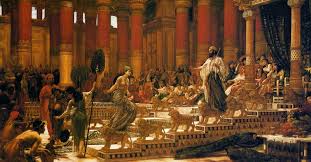
There are many more passages in the Old Testament which have been understood as applying to Christ, but there is something quite specific in the Book of Ecclesiastes. You will recall the words of this book are delivered in the name of King Solomon. The ancient tradition of the Church, found in writers such as Didymus, Origen, and Gregory of Nyssa, is that Solomon was an antetype of Christ. Even the title he takes, Ecclesiastes, the preacher or the speaker in the assembly, refers to the Church of Christ as much as to anyone in the time of Solomon. Origen noted that Solomon followed the type of Christ in his ruling over Israel with wisdom, in his name which means “peaceful,” and in the way that Gentiles, such as the Queen of Sheba, came to behold him. Didymus the Blind, dying about the year 395, and therefore an older contemporary of St Maroun said that Solomon, in speaking as the Ecclesiastes, teaches what is needful for the Church.
Equally, as St Didymus said: the Spirit is the author of Scripture, although the Spirit does not write the letters, but inspires the soul of Solomon and the other wise men who probably joined in the writing of Ecclesiastes.
So we are entitled, therefore, to take this book as the teaching not only of King Solomon, who is its traditional writer, but by the inspiration of the Holy Spirit, he is speaking as the mouthpiece of Christ Himself. Evagrius is recorded as having said that “Ecclesiastes is Christ, the author of true knowledge of the ages and worlds, but that Ecclesiastes could also be understood as everyone who “having purified the soul by moral contemplation, leads his soul to the contemplation of the physical world.” The meaning of this is that we have to learn to apply the words of this book to ourselves.
Let us now look at the opening poem of this book:
The words of the Preacher, the son of David, king in Jerusalem. Vanity of vanities, says the Preacher, vanity of vanities! All is vanity. What does man gain by all the toil at which he toils under the sun? A generation goes, and a generation comes, but the earth remains forever. The sun rises, and the sun goes down, and hastens to the place where it rises. The wind blows to the south and goes around to the north; around and around goes the wind, and on its circuits the wind returns. All streams run to the sea, but the sea is not full; to the place where the streams flow, there they flow again. All things are full of weariness; a man cannot utter it; the eye is not satisfied with seeing, nor the ear filled with hearing. What has been is what will be, and what has been done is what will be done, and there is nothing new under the sun. Is there a thing of which it is said, “See, this is new”? It has been already in the ages before us. There is no remembrance of former things, nor will there be any remembrance of later things yet to be among those who come after.
The Syriac word for vanity is hbel, identical with the Hebrew word. It means “vanity” or “empty.” The Hebrew word habel has the same meaning, referring to what is transient, to what passes like mist. So we are here speaking of “vanity” not so much as prickly and sensitive self-esteem, but as what is vain because it is futile, it is an action accomplished only in fantasy. It lacks reality, meaning a tangible and lasting existence. What is vain does not correspond to the truth, because God is truth, and although He shows us many faces, He abides eternally and the works of goodness, truth, and beauty are taken up into His unity.
In this poem from the first chapter of Ecclesiastes, we are being told that everything in this passing world is futile because it is a ceaseless and pointless repetition of what has gone before, going nowhere. If we read this passage as a poem by an unknown Hebrew author who was adopting a disguise we have now seen through, there is not very much more to it. So what, we might ask, that is his opinion, why should I accept it? As Scripture, I might respect it, and think it worth considering, but it seems that every modern commentator on this book argues with the author, scrutinises it for contradictions, and purports to expose it as a late book written under the influence of Greek philosophy, with very little to commend it.
However, if we read it as almost two thousand years of Christians did, especially in pre-modern Europe, and even into contemporary times in the Middle East, it is very different. Read it as if it had been written by King Solomon himself, and a light comes on. It ties in with the Old Testament accounts of that wise and powerful king, and is his deathbed testimony, for as we shall see, the train of thought travels slowly but surely towards the final moment, when the soul returns to God.
In this light, the book is a personal witness. He has been the monarch of a wonderful kingdom, and seen grandfathers, fathers, and sons come and go. He has seen dynasties rise and fall. The more he has had, the more he has wanted. The more he has discovered, the more he has realised he does not have, and the longing to possess it engulfs him and does not leave him. He obtains what he sought and then the next obsession has beckoned to him. Consider all the kings of the world who conquered as far as the horizon, and then discovered that the horizon stretches forward, on and on without end. Consider all the ruins of ancient civilisations King Solomon would have seen, of which people remembered only a name. Solomon was the last of the kings to rule over a united Israel. No matter how great he was, he could not make it so that it held together forever.
But now, let us read it as if it were Christ Himself who is speaking, as indeed, from one perspective it is. It now takes on not just a new light but a new dimension of meaning. We are reading now the blueprint of life on earth, under the sun. This is how it is: vanity of vanities. This is the design, the very DNA of our life, that it lasts for a time, repeats, and is in a continual process of growing and fading, appearing and disappearing.
This is the law of earthly life: we are all under it. No one is free of it, not even the king. More precisely, no one is above this law of life, not even the most powerful man on the earth. When we see this as the disposition of Christ, His divine ordinance for man, then we see more clearly the meaning of some of the other verses in this book. The most important of these is chapter 12, the final chapter, which says:
Remember also your Creator in the days of your youth, before the evil days come and the years draw near of which you will say, “I have no pleasure in them”;… and the dust returns to the earth as it was, and the spirit returns to God who gave it. (12:1-7)
This is an absolutely unmistakable allusion to Genesis 2:7: “ the Lord God formed the man of dust from the ground and breathed into his nostrils the breath of life, and the man became a living creature.” When this happens to us at the moment of death, then we are no longer under the law of life under the sun: for as we have seen, God is the father of the lights of heaven.
The very last words of the book tell us what we should do now to deal with the situation we will meet then: “Fear God and keep his commandments, for this is the whole duty of man. For God will bring every deed into judgment, with every secret thing, whether good or evil.” We should remember that the ways of God are beyond our minds, and so we must trust in him. Solomon tells us: “As you do not know the way the spirit comes to the bones in the womb of a woman with child, so you do not know the work of God who makes everything.” (11:5) And later: “Walk in the ways of your heart and the sight of your eyes. But know that for all these things God will bring you into judgment. Remove vexation from your heart, and put away pain from your body, for youth and the dawn of life are vanity.” (11:9-10)