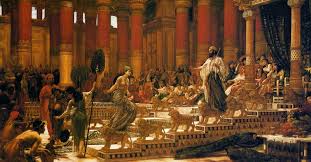
We have been studying the Book of Ecclesiastes. We have seen that it is traditionally understood as inspired by the Holy Spirit so that when King Solomon speaks he does so as the voice of Christ Himself, one thousand years before the Incarnation. The notable ascetic Evagrius Ponticus, a contemporary of Ss Maroun and Didymus the Blind, taught that “Ecclesiastes is Christ, the author of true knowledge of the ages and worlds, and that Ecclesiastes could also be understood as everyone who “having purified the soul by moral contemplation, leads his soul to the contemplation of the physical world.”
It has long been said that Solomon wrote three books: Proverbs in his younger days to teach the right way to live; Ecclesiastes in his middle age to show us that the world can never fulfil our legitimate desires, and the Canticle of Canticles, or Song of Songs, in his old age, as a mystic revelation: the unveiling of the sublime mysteries which cannot be found in this world of life under the sun.
In this episode, we shall examine Evagrius’ deep insight: that it is possible to purify the soul by moral contemplation, and so look boldly and clearly at the world with the eyes of the soul.
Evagrius said that when we have been cleansed, internally, we no longer need to see the beauty of the world only for refreshment or as a diversion; rather, we can through the natural world penetrate to the contemplation of the spiritual world. In such a case, I would say, we do not lose our love of nature, but rather it is eclipsed by the greater love we begin to feel for God – He who is, as Hopkins said “beauty’s self and beauty’s giver.” Thus the lesser love which we have for the goodness in the world, is subsumed by the brighter love and longing for He who is the source of that goodness. Our love of the divine may never become perfected while we are in the body, just as our wisdom is never complete; but if we start to come out of our addiction to material things, then godly love and wisdom can grow. This, I suggest, is a large part of the message of Ecclesiastes: let go of the lesser love and pride in what knowledge we have, in order to possess the greater. However, in that very short book, the emphasis is on the letting go more than it is on the possession.
One major lesson of Ecclesiastes is that we need to be impartial to both happiness and sorrow, to both the letting go and the possessing which are inherent in life. In episode 21 we looked at the remarkable poem in chapter 3: that there is a time for every purpose. At the end of it, it teaches: “I have seen the business that God has given to the children of man to be busy with. He has made everything beautiful in its time. Also, he has put eternity into man’s heart, yet so that he cannot find out what God has done from the beginning to the end.” (3:10-11)
In some instances, sorrow is better for our souls and our eventual enjoyment of the beatific vision. Paraphrasing the words of Ecclesiastes, St Ambrose wrote: “If anyone wants to ascend, let him seek not the joys of the world or the pleasant things … it is better to go into a house of sorrow than into a house of rejoicing. Indeed, Adam would not have come down from paradise unless he had been beguiled by pleasure”.
When we look at the world through the eyes of Christ, the Ecclesiastes, we start to notice and not to explain the injustices in the world, even injustices performed by those who are supposed to maintain the rule of law. He says:
Moreover, I saw under the sun that in the place of justice, even there was wickedness, and in the place of righteousness, even there was wickedness. I said in my heart, God will judge the righteous and the wicked, for there is a time for every matter and for every work. (3:16-17)
We see then, that although this book is made up of some poems, and a number of wise sayings, there is yet a certain continuity and coherence. All the consistency, all the apparent contradictions, all the remarkable features of the book, turn around God and His presence or His apparent absence. It is our lack of awareness of the intents of God which leads us to be perplexed.
For example, in one place Ecclesiastes says that pleasure, joy and wine are all vanities (2:1-3) but later it says: “Go, eat your bread with joy, and drink your wine with a merry heart, for God has already approved what you do” (9:7). But the point is that amusements and wine are indeed all in vain if they are taken as aims in themselves; but they are legitimate aspects of life in the world if they are taken as the gifts of God. After all, Solomon has said that God has placed eternity, meaning the desire for eternal life, in our hearts (3:11), and if we make eternity with God our aim, then all innocent joys which we find along the way are legitimated.
The solution to this riddle is that the yearning for eternity is in our hearts. It is something we can feel, but is not something we can understand. The whole point is that we are on the earth, under the sun: we are not with God in heaven.
I think that this also helps to explain the apparent inconsistencies in what is said about wisdom. You will recall that it says that: “in much wisdom is much vexation, and he who increases knowledge increases sorrow” (1:18); and that both the wise and the fool die and so all is vanity (2:12-17). But then, wisdom is also praised at the end of the book, where it is said: “The words of the wise are like goads, and like nails firmly fixed are the collected sayings; they are given by one Shepherd. My son, beware of anything beyond these. Of making many books there is no end, and much study is a weariness of the flesh” (2:11-12).
That provides for the context for both the praise and the dismissal of wisdom. What is being disvalued is worldly knowledge, the acquisition of information, we might say. But Ecclesiastes praises the divine knowledge which is found in Scripture and the words of the truly wise: that, after all, is why he has collected so many proverbs in this book.
Thus once more, we find that the point of distinction in this book between what is valuable and what is not is the sun: there is life beneath the sun and all which pertains to it, whether joy, wine, or wisdom, and all that has value only in so far as it prepares us for life with God and in eternity.
So now let us look at our lives. Take politics. People join political parties because they believe in something, but then, as soon as they do, they find that they have to compromise. They have to make deals. The struggle for power becomes an end in itself.
Take culture, or what passes for it. Music, film, television, all are subject to the great idol of money. People with genuine talent and a love of their art often go nowhere because they could not scrape their way into the business; and when they do, how often does the very success they have found undermine them? Some people have had fame and money, and when their latest efforts fizzle, their depression is worse than their delight had ever been. Others acquire a name and then spend their lives in bitter competition with other people. Some find a worse fate in their very success, especially in their lasting success, because they begin to believe their own publicity, and see themselves not only as actors but as wise statesmen, whose opinion on whom to vote for, and what moral cause to uphold, should be gratefully accepted by others. In other words, they become an elite in the own minds, and the danger is greater if they are also an elite in the minds of other people.
Not all success has to end like this, but what Ecclesiastes is teaching us is that if it does not it is not because of the success, it is because of the fear of God and the love of His goodness, truth, and beauty. No matter who we are, however poor or rich, famous or unknown, the only success which matters is that which is in our souls: and that does not depend on what is in the world.
Let us taken an analogy. Imagine you have rowed a boat to shore. When you get out, you tie it to something stable, not to something which is itself floating. What Ecclesiastes is saying is that only God is a stable place to which to attach the boat of our souls. Otherwise we are just leaving our boats on the ever-flowing river of earthly life. What is unchanging is what is eternal.
Likewise, there is a certain love which is an obsession and a foolishness because it is linked to the inconstant hearts of people; what Shakespeare called “fickle changelings.” This does not mean not to love other people. Rather, we are commanded to. But we love them for and in God, and for their souls, and not for what they do for us. Accept the smiles of our friends, but look beyond them, and place our ultimate trust in God.