I have proposed that Wisdom is the natural operation and guidance of the godly soul in this world. It could be considered as an interface between the divine plan for humanity, and the human faculties of reason and judgment. The mind we use in exercising wisdom, if we ever do exercise it, is not the one we use when exercising our knowledge, although to be accurate, wisdom includes and employs our knowledge. Wisdom is the work of a higher mind: so high that the distinction between intellect and feeling disappears. The Song of Songs, also known as The Canticle of Canticles speaks from and to this higher level in its most sublime form: the mystic experience of the presence of God. It brings a most important insight: that the experience of the presence of God is necessarily accompanied by that of His absence, and that the basis of both of these is love – the divine love which changes us by uniting us to Him.
The Song of Songs was known as The Canticle of Canticles. This last title, which was used by the Church for many years, tells us how the book was viewed, for although the word “canticle” was originally a little song, it came to be used for hymns, especially for the hymns found in Scripture. It is related to the word “chant.” To call it the “song of songs” means that it is the greatest of songs. This is, I suggest, because of how it depicts divine love: everyone can relate to it in some way, even if they take it on a purely human level.
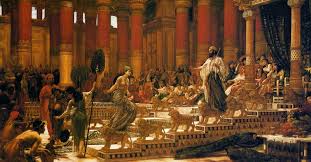
Traditionally, it was taken as written by King Solomon, but he was only the instrument: the true author, of course, was the Holy Spirit. He also, in this canticle, was the bridegroom, and the bridegroom, in turn, represented Christ. St Gregory of Nyssa said that in Proverbs, Ecclesiastes, and these canticles, Christ uses Solomon as His voice or instrument to teach us the ascent to perfection. The ascription to Solomon tells the faithful to “expect something great and divine.” (Wright 287)
Bear that in mind when you hear this passage from chapter 5, a section which has been beloved of mystics who seek to experience the presence of God:
I slept, but my heart was awake. A sound! My beloved is knocking. “Open to me, my sister, my love, my dove, my perfect one … My beloved put his hand to the latch, and my heart was thrilled within me. I arose to open to my beloved … but my beloved had turned and gone. My soul failed me when he spoke. I sought him, but found him not; I called him, but he gave no answer. The watchmen found me as they went about in the city … I adjure you, O daughters of Jerusalem, if you find my beloved, that you tell him I am sick with love.
I have edited this passage by omitting a few phrases so that its movement is more apparent. Taking Christ as the beloved, we have a picture where He knocks on the door of our hearts, awakening us, as it were, to His presence. He wishes to come to us, but “my soul failed me when He spoke.” We were not ready, just a little hesitant, and by the time we have aroused ourselves to welcome Him, He has disappeared, for God wants us to be waiting for Him, and if we miss the moment, to go in search of Him. The soul then goes into the streets in quest, and asks everyone else to help her in her search. The word “adjure” literally means “put an oath to,” but it also came to mean to make a request of someone with as much earnestness as if putting them to an oath: which is, after all, a promise before God.
I know that many people, especially many scholars of Scripture consider this book to be ordinary songs of love: the danger of reading it that way is why the Church adopted the Jewish tradition of only allowing those who had reached the age of 30 and had studied other Scriptures to begin to study it. But really, who can seriously say that in a traditional society like that of ancient Israel, a woman was awoken by a man coming to her door, who then went without waiting for an answer, and then she went out wandering in the streets to find him, and asked other women to be her lookouts? Even the reference to the daughters of Jerusalem provides the religious context for her request to give her beloved the message that she is sick with love.
Ancient and medieval commentators who tried to read these verses literally ran into all sorts of difficulties: for the words of the canticles can hardly make narrative sense, thus we read in chapter 1:
Black am I, but beautiful, O daughters of Jerusalem, like the tents of Kedar, like the curtains of Solomon. Do not gaze at me because I am dark, because the sun has looked upon me. My mother’s sons were angry with me; they made me keeper of the vineyards, but my own vineyard I have not kept!
The idea of blackness being beautiful was problematic, very problematic, even for Jewish readers. This is a sign that it cannot be taken literally. Attempts to interpret the vineyard as her body hardly help: why could any woman’s brothers make her responsible for her own bodily care? And why were they angry with her? And are her parents dead, so that her brothers have a free hand? But if it is read as a soul which can be comforted by nothing but God Himself, then it starts to make sense. The soul is humble, but is lovely to its Creator. Other people are impatient with the person who is fixated upon God, and want to get it involved with other things, but while the person in love with God can be pressured to do something for others, he will neglect himself, for to the extent he has control over his actions, he seeks God – and nothing else.
This is why Origen, Ambrose, and other Fathers say that the Canticle has no corporeal or fleshly meaning: spiritually, it is Christ and His Church. To read these verses as if they represent a genuine human love affair results in as much absurdity as one could desire. Those who included this book in Scripture knew quite well what they were doing. The bride is indeed the Church and the bridegroom is Christ. The references to “breasts” are symbolic of love and the heart (Wright 286) And when it comes to blackness of the woman, they are agreed that this is the soul admitting that it is sinful and not worthy of God, who is, we can say, its lover.
As with most Scripture, one interpretation is not sufficient to exhaust its richness. The praises of the women in the Canticle are even more true of Wisdom than they are of the individual believer, as one early medieval Jewish commentator said (Pope 90), Beyond that, they are also true of the Mother of God. The Marian interpretation comes readily to mind, and was naturally used by St Therese the Little Flower, for example. Thus, in verse 1:15, the Bridegroom says: “Behold, you are beautiful, my love; behold, you are beautiful; your eyes are doves.” This is said of the beauty of her soul. Then in verse 2:2 “As a lily among the brambles, so is my love among the young women,” thus tying in with Our Lady being the greatest of all God’s creatures, or as we say in the Hail Mary, following the archangel Gabriel, “Blessed art thou amongst women.”
So natural is this interpretation that the traditional Latin feast of the Apparition of the Mother of God at Lourdes (11 February) has these lines from chapter 2 of the Canticle of Canticles in the Gradual chant: “The flowers appear on the earth, the time of pruning has come, and the voice of the turtledove is heard in our land. Arise, my love, my beautiful one, and come away. O my dove, in the clefts of the rock, in the hollow places of the wall.”
Then, an antiphon written for the Feast of the Purification of the Mother of God (2 February), based on the Canticle, reads:
Deck thy bridal chamber, O Zion, and receive Christ, thy King. Embrace Mary, who is the gate of heaven, for she carries the King of Glory of the new light; a virgin, she stands bringing in her hands the Son begotten before the daystar …
In the Feast of the Miraculous Medal, the Alleluia of the Mass cites chapter 4 of Canticles: “Thou art all fair, my love, and there is no spot in thee.” In the Feast of Our Lady of Perpetual Succour, it extracts chapter 6: “Thou are all lovely and sweet, O daughter of Sion, beautiful as the moon, bright as the sun, terrible as an army in battle array.”
This makes sense for she of whom it was prophesied her offspring would bruise the head of the serpent. We can, and should, therefore, read The Song of Songs as a mystical treatise in which human love is used as the basis of the poetry and imagery, in order to indicate the divine love which is ultimately above and beyond human expression.