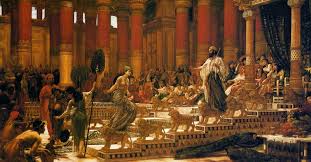
We have already seen some of the third chapter, but it also includes these wonderful lines: “I held him, and would not let him go until I had brought him into my mother’s house, and into the chamber of her who conceived me.” This is a sublime exhortation to seek for Christ and having found Him to never be separated from Him. The chapter closes with a vivid and poetic invocation of King Solomon:
What is that coming up from the wilderness like columns of smoke, perfumed with myrrh and frankincense, with all the fragrant powders of a merchant? Behold, it is the litter of Solomon! Around it are sixty mighty men, some of the mighty men of Israel, all of them wearing swords and expert in war, each with his sword at his thigh, against terror by night. King Solomon made himself a carriage from the wood of Lebanon. He made its posts of silver, its back of gold, its seat of purple; its interior was inlaid with love by the daughters of Jerusalem. Go out, O daughters of Zion, and look upon King Solomon, with the crown with which his mother crowned him on the day of his wedding, on the day of the gladness of his heart.
Simply reading this fills one’s soul with joy. The opening of chapter 4 is often understood as being spoken by Solomon to his beloved, and also, in the spiritual interpretation, by Christ to the soul:
Behold, you are beautiful, my love … Your eyes are doves behind your veil. Your hair is like a flock of goats leaping down the slopes of Gilead. … Your lips are like a scarlet thread, and your mouth is lovely. Your cheeks are like halves of a pomegranate behind your veil. Your neck is like the tower of David, built in rows of stone; on it hang a thousand shields, all of them shields of warriors. … Until the day breathes and the shadows flee, I will go away to the mountain of myrrh and the hill of frankincense.
Come with me from Lebanon, my bride; come with me from Lebanon. Depart from the peak of Amana, from the peak of Senir and Hermon, from the dens of lions, from the mountains of leopards. You have captivated my heart, my sister, my bride; you have captivated my heart with one glance of your eyes, with one jewel of your necklace. How beautiful is your love, my sister, my bride! How much better is your love than wine, and the fragrance of your oils than any spice! Your lips drip nectar, my bride; honey and milk are under your tongue; the fragrance of your garments is like the fragrance of Lebanon. Your shoots are an orchard of pomegranates with all choicest fruits … a garden fountain, a well of living water, and flowing streams from Lebanon. Awake, O north wind, and come, O south wind! Blow upon my garden, let its spices flow.
Of course, as a Maronite, I cherish the references to Lebanon. But Lebanon is not here by accident. King Solomon’s temple was built by Hiram of Tyre and his Phoenician craftsmen, and Mount Lebanon was considered one of the dwellings of God. It was a blessed land in the mind of the peoples; and these references are constant in the Canticle. It is but one more sign that the desire expressed in this beautiful book may begin on earth but it ascends to heaven.
In chapter 5, the first verse is spoken by the bridegroom: “I came to my garden, my sister, my bride, I gathered my myrrh with my spice, I ate my honeycomb with my honey, I drank my wine with my milk. Eat, friends, drink, and be drunk with love!” From the traditional perspective, these images bring us to reflect upon two forms of communion: both the Eucharist and the union of the soul with God. To be drunk, as the Fathers said, is not meant literally, but in the sense of a change of state – the mind and heart are lifted above the world to its Creator.
In previous posts, we have seen some of the souls’ reply, and she continues in verses 11-:
His head is the finest gold; his locks are wavy, black as a raven. His eyes are like doves beside streams of water, bathed in milk, sitting beside a full pool. His cheeks are like beds of spices, mounds of sweet-smelling herbs. His lips are lilies, dripping liquid myrrh. His arms are rods of gold, set with jewels. His body is polished ivory, bedecked with sapphires. His legs are alabaster columns, set on bases of gold. His appearance is like Lebanon, choice as the cedars. His mouth is most sweet, and he is altogether desirable. This is my beloved and this is my friend, O daughters of Jerusalem.
Note the conjoining of allusions to two holy places: Jerusalem and Lebanon.