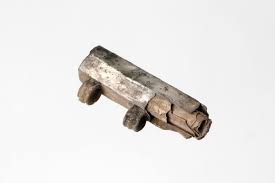
A rather significant archaeological discovery was notified to the public in December 2024. Perhaps the most significant aspect of it is the artefact itself: a silver case with a Christian prayer written on silver foil. The very fact that a Christian who had died by 270 was using what amounts to a sacramental, is the great discovery.
The Ancient History Magazine of December 2024, states:
A remarkable archaeological discovery in Frankfurt, Germany, has unveiled a small silver amulet, measuring just 3.5 cm, known as the ‘Frankfurt Silver Inscription’. Deciphered using computer tomography (CT) to create a 3D model, the text that can now be interpreted entirely in Christian terms – an extraordinary find for its time.
The amulet was discovered in the Heilmannstraße cemetery, part of the ancient Roman city of Nida. Excavations revealed 127 graves there, predominantly inhumations, and uncovered various unusual grave goods, including glass and jewellery, indicating a connection to high-quality burials typical of Roman urban centres.
The silver amulet, found in the grave of a 35-45-year-old man, contained the rolled silver foil with an inscription, which ran to eighteen lines in Latin, that reads:
[I.“(In the name?) of St Titus. Holy, holy, holy! In the name of Jesus Christ, Son of God! The Lord of the world resists [to the best of his ability?] all attacks(?)/setbacks(?). The God(?) grants the well-being entry. This means of salvation(?) protects the person who surrenders to the will of the Lord Jesus Christ, the Son of God, since before Jesus Christ all knees bow to Jesus Christ: the heavenly the earthly and the subterranean, and every tongue confess (to Jesus Christ).”]
Dating to ca. AD 230–260, the amulet represents the earliest authentic evidence of Christianity found north of the Alps. While there are historical references to early Christian groups in Gaul and Upper Germania, incontrovertible evidence of Christian life in northern Alpine regions generally only appears from the fourth century AD.
The Jerusalem Post gives more details:
An ancient silver amulet unearthed in Frankfurt has been revealed as one of the earliest known testimonies of Christianity in Northern Europe, pushing back the history of Christianity in the region by several decades. The amulet, (was) discovered in 2018 during excavations at a Roman cemetery in the Frankfurt district of Praunheim …
The small silver amulet, approximately three and a half centimeters long with two loops on top, was found in a grave dated between 230 and 270 CE—a time when openly identifying as a Christian could be life-threatening due to ongoing persecution. Inside the amulet was a fragile, inscribed silver foil, known as the “Frankfurt Silver Inscription,” which was so delicate that unrolling it would have caused it to crumble. …
Markus Scholz, an ancient historian from Goethe University Frankfurt, led the effort to decode the 18-line Latin inscription. “Sometimes it took weeks, even months, until I had the next idea,” Scholz stated, as reported by T-Online. The text includes invocations to Jesus Christ, entirely in Latin. “That’s unusual for this time. Normally, such inscriptions in amulets were written in Greek or Hebrew,” Scholz noted …
The inscription begins with a mention of Saint Titus, a disciple and confidant of the Apostle Paul, and includes a prayer to “Jesus Christ, Son of God,” intended to protect the bearer. It also features the Trisagion—the “Holy, Holy, Holy”—known from Christian liturgy in the 4th century CE. The inscription concludes with an almost literal quote from the Christ hymn of Paul from his letter to the Philippians (Philippians 2:10-11).
Experts consider this discovery extraordinary for its time and location. Süddeutsche Zeitung reported that the find “pushes back the history of Christianity in Frankfurt and beyond by about 50 to 100 years.” Until now, secure evidence for Christian life in the northern Alpine regions of the Roman Empire generally dated from the 4th century CE.
The man buried with the amulet was aged between 35 and 45 and had been interred with grave goods, including a censer and a jug made of fired clay. The presence of the Christian inscription suggests that he openly identified himself as a believing Christian, which was a significant risk during a period of persecution. As reported by Bild, this indicates the depth of his commitment during a time when practicing Christianity could be life-threatening.
… “This extraordinary find touches many areas of research and will occupy science for a long time. This concerns archaeology as well as religious studies, philology, or anthropology. … The discovery challenges previous historical assumptions about the spread of Christianity in the region. Nida, the Roman predecessor city to modern Frankfurt, was an administrative, economic, and religious center known as the main town of the Roman administrative unit Civitas Taunensium. “The text of the inscription shows that Nida at this time was not a peripheral border region but had cultural influences from the whole Empire, especially since the population came from various parts of the world empire,” Scholz said.
Note the references to the praise of the angels from Isaiah 6 (Holy, holy, holy) and the Epistle to the Philippians (the name of Jesus before which all must bow). But what is also significant is that according to the only text of the inscription I can find (Wikipedia) the “Holy, Holy, Holy” is in Greek, “Agios, Agios, Agios.” This may reflect the writer’s text of Isaiah, but it may also be liturgical, for this is obviously one other context the Greek would be retained at this time.
I wonder if the man who owned the amulet was not named Titus, as it is odd that the name of the saint came before the name of Jesus. The reference to the “Lord of the World” is not to the Evil One (John 14:40 and 1 John 5:19).
The final question: what is “the means of salvation”? I wonder if it could be the Eucharist, or even the entire Divine Liturgy. One of the commentaries in an online newspaper says that there is no evidence the Holy, Holy, Holy was used in the liturgy until the fourth century. But the issue is that we have almost no surviving texts whatsoever about the liturgy – so that is rather meaningless.
This is not overwhelming evidence, but it is more reason to think, as we have always known, that we think of as the “Catholic” Church is indeed the original and authentic Christianity.