We continue our study of the Syriac text of Dionysius’ Mystical Theology. Once more, it seems to me to be simpler than the surviving Greek text. From 77va, pp.107-108 of Fiori’s text, I first present a literal translation, then investigate the meaning and present a smoother version:
(However) If the divine raze (mysteries or sacraments,) are above these (people) what will one say concerning those who are far off from the raze, those who – of the cause, raised above all – truly from other things/matters with/by these things they make representations of it; and not saying of the highest (that it is) in any way higher than the profane, or than the many images, forms which they have composed for themselves.
Compare this with Luibheid’s translation from the Greek: “And if initiation into the divine is beyond such people, what is to be said of those others, still more uninformed, who describe the transcendent Cause of all things in terms derived from the lowest orders of being, and who claim that it is in no way superior to the godless multiformed shapes they themselves have made?” The meaning is the same, but the Syriac translation is clearer.
Dionysius had been speaking of people who are “seized by” the material phenomena of the creation, and deny anything higher to exist. This suggests that he is writing in a sophisticated environment where there is a deep cynicism about spiritual matters based on their own presumed high knowledge. I could be quite mistaken, but it sounds to me as if he is speaking about atheistic philosophers. Then, in the passage under discussion, he speaks of people who are likewise far from the raze, the mysteries or sacraments, but who do not actually deny that there is anything more than the material world, but rather, who make images and say that these are divine. It seems to me that here he means polytheists or pagans. These could be idolaters or, possibly, more philosophical Neoplatonic types, perhaps practitioners of theurgy.
It continues in a passage I find very difficult to come to a satisfactory reading of, because there seem to me to either be unnecessary words, or – and this is more likely – words whose sense I do not comprehend, in this context:
It is right for these people that (in) all they write about these things, let them compose and say this about the cause of all, so, let them all keep far away from it, accuracy as it is of a being is far beyond everything.
Given what Dionysius has said about the cause being beyond itself beyond being, I am not sure that this is quite what is being expressed, although I think that the drift is clear. Fiori has, in translation from his Italian: “Indeed, it would be necessary for them to compose and affirm about Her all the positions that are, as [composed and affirmed] regarding the cause of everything. and that, moreover, they appropriately removed all things from Her.”
This could well be correct, except that the word zodeq, does literally mean “it is right” rather than “it is necessary.” Dionysius is speaking of a moral obligation, I think, more than a linguistic or even philosophical one. Luibheid translates the Greek as follows: “What has actually to be said about the Cause of everything is this. Since it is the Cause of all beings, we should posit and ascribe to it all the affirmations we make in regard to beings: and more appropriately we should negate all these affirmations since it surpasses all being.”
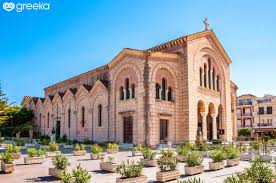
The illustration is of a Church of St Dionysius