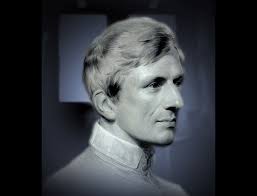
St John Henry Newman is a hero of the Church. He was not only one of the best, but also one of the sanest people who has ever lived and left enough evidence for us to judge. If I had to select three distinguishing aspects of his life and work to praise, I would say: first, the unwavering firmness and completeness of his faith in God; second, his almost perfect intellectual judgment; and third, the patient urgency with which he addressed the needs of the faithful and the Church. Together, these qualities contributed to his manifesting just the type of holiness needed for the place and age in which he lived.
Before I tackle these, we should know that, speaking in the year of grace 2025, we are two and a quarter centuries from his birth in 1801, and just over one hundred and thirty years from his death in 1890. When I was a child, some elderly people still lived who, as children or adolescents, would have seen and spoken to him when he was Cardinal Newman. But none of those people survive today. So, although his life fell not within our lifetimes, or our parents’, neither was he so very far removed from us; and his intellectual and spiritual legacy is growing daily. The announcement that he will be made a Doctor of the Church and the reissuing of all his work in the Millennium Edition is evidence of that. In his New History of Western Philosophy, vol. 4, Anthony Kenny straightforwardly asserts that Newman was “the greatest religious writer of the Victorian age,” (28) and his treatment of “belief and certainty” was “arguably the best treatment of the topic … between Hume and Wittgenstein,” meaning the period from before the French Revolution to the middle of the twentieth century (28-30).
St Newman lived all his life in England with the exception of certain trips he made to Europe, and especially to Rome. Everything about him is eloquent of his Englishness, not least the fact that he is the most celebrated ever convert from the Church of England to the Catholic faith.
Paradoxically, his most celebrated book, the Apologia pro vita sua, stems from the fact that he was despised as a traitor by many Anglicans. The very viciousness and injustice of their attacks, called forth his masterful and overwhelming self-vindication, a work so great that it stands as a spiritual classic without any further reference to the controversies which provoked its appearance. Between 1845 and 1864, when it was written, he was being treated as a spent force. He was even treated with suspicion and some hostility by a number of influential co-religionists within the Catholic Church. Yet, while the Apologia is a sound basis for considering him a lighthouse of spiritual practice and religious thought, he produced many other works which also attest to his extraordinary abilities and graces. What I will highlight in these posts, more than anything else, is the spirituality of St John Henry Newman. This has by no means been ignored by those who have read his writings. But his fame as a religious thinker has far outrun the esteem and affection which are, I would say, his due as a faithful servant and worshipper of his Lord. When he was honoured with a cardinal’s hat in 1879, he chose as his motto: cor and cor loquitur, “heart speaks to heart.” He chose to place in the foreground the heart, not the intellect; religious feeling, not apologetics.
Now, I mentioned his unwavering and complete faith in God. I mean by this that his unmovable faith filled every corner of his life. Consider this excerpt from the Apologia:
… I am a Catholic by virtue of my believing in a God; and if I am asked why I believe in a God, I answer that it is because I believe in myself, for I feel it impossible to believe in my own existence (and of that fact I am quite sure) without believing also in the existence of Him, who lives as a Personal, All-seeing, All-judging Being in my conscience. (182, Penguin)
This is quite a startling statement. It is not an argument for the existence of God, it is his statement why he was certain of the existence of God. So far as I am aware, the statement is unique. No one else I know has ever said that God is so integral a part of his consciousness of existence, and of his conscience (note that reference) that to be aware that he lives is also to know that God lives, and that to doubt or deny the existence of God, he would have to doubt or deny his own.
The second matter, his intellectual judgment, which was practically flawless, shall emerge over the next posts. So too, what I call his “patient urgency” for the faithful and the Church is shown in the number of controversial issues which he addressed in his work, from the position of the Anglican Church at a time when it was under attack from within and without, through to his defence of belief in God, and his assertion of the need to have a good all-round education of the whole person according to a Catholic ethos. One pressing matter which he wrote on, and which we shall examine now, is the teaching on repentance and Purgatory. That brings us to The Dream of Gerontius, written in 1865, a lengthy poem, really a series of connected poems linked together in a narrative.
“Gerontius” is just a generic name, taken from the Greek word gerōn, meaning “an old man.” Gerontius has come to the end. He dies, is judged, and is sentenced to Purgatory, which means that he shall eventually be numbered among the saints in heaven. It sounds simple, if very unusual for poetry. Newman’s treatment has given this work its ongoing popularity. It is called a “Dream” but it is in fact an imaginative, almost prophetic glimpse of eternity
The opening words are “Jesu, Maria – I am close to death, / And thou are calling me …” Gerontius describes the horror of ceasing to be, for he fears that he: “must needs decay / And drop from out the universal frame / Into that shapeless, scopeless, blank abyss, / That utter nothingness, of which I came …” (1-2) There is no attempt to hide the terror of death. At his earnest request, those who are near him ask all the hosts of heaven to pray for their friend. Heartened by their prayers, Gerontius says: “Rouse thee, my fainting soul, and play the man; … Prepare to meet thy God,” (3) and delivers himself of the magnificent hymn: “Firmly I believe and truly / God is three, and God is One.” (5) Declaring: “I take with joy whatever / Now besets me, pain or fear, / And with a strong will I sever / All the ties which bind me here.” (6)
Finally, the moment comes, and the priest prays for him: “Go forth upon thy journey, Christian soul! Go from this world! Go, in the name of God the omnipotent Father, who created thee!” (9) This noble prayer, chanted like a canticle, ends section I.
to be continued