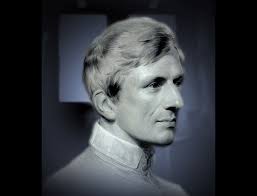
The soul of Gerontius speaks the first words of section II: “I went to sleep, and now I am refresh’d / A strange refreshment; for I feel in me / An inexpressive lightness, and a sense / Of freedom, as I were at length myself, / And ne’er had been before.” (10-11) In other words, the true self is hemmed in and our consciousness of ourselves is dimmed by the noise of the world. With an imaginative leap, Newman describes what he intuits the first moments of the newly released soul must be like: So much I know, not knowing how I know, / That the vast universe, where I have dwelt / Is quitting me, or I am quitting it. / Or I or it is rushing on the wings / Of light or lightning on an onward course / And we e’en now a million miles apart.” (12-13)
Then comes one of the most original lines I have ever read: this soul says: “… someone has me fast within his ample palm; ‘tis not a grasp / Such as they use on earth, but all around / Over the surface of my subtle being, / As though I were a sphere, and capable to be accosted thus, a uniform / And gentle pressure tells me I am not / Self-moving, but borne forward on my way.” (13) He hears his guardian angel giving thanks that he has brought home to God the soul in his charge. The angel says of man that he was “polluted in the blood of his first sire. / With his whole essence shattered and unsound, / And coiled around his heart, a demon dire.” (15-16) Gerontius realises that he has left his body altogether, but in the company of his guardian angel, he is full of peace and confidence: “… now I am / So whole of heart, so calm, so self-possessed, / … Nor have I even terror at the thought that I am clasped by such a saintliness.”
Section III opens with Gerontius asking his guardian angel why he is not yet in the presence of God. The surprising reason is: “It is thy very energy of thought / Which keeps thee from thy God.” (21) This is, on one reading, very similar to what has been said by several mystics from various cultures and religions: that our own busy thought weaves the veil between us and God, which may be why we feel God to be closer when we are children, that is, before our minds have trapped us.
But Newman says more: the angel explains that in the world, time is measured by objective standards, the movements of the sun and moon, the ticking of the clock. But here, on the other hand, “intervals … are measured by the living thought alone, / And grow or wane with its intensity. And time is not a common property / But what is long is short … as received and grasped / By this mind and by that …” (21)
In other words, time is quite different in the next life: it is subjective, and varies from individual to individual. This makes sense, for time has no power over spirits, and there is no sun or rotation of the earth; in fact, it is possible that nothing in the next world suggests time except for thought. This raises the question: would it be possible for us now, in this life, to have a foretaste of the spiritual life by stopping thought, albeit for a flash? And could this be how St Newman came to this idea?
The soul asks his angel why it is that all through life he feared the prospect of the judgement, but now his fear has disappeared and he feels only a serene joy. The angel answers: “It is because/ then thou didst fear, that now thou dost not fear.” (22) In fact, judgment has already begun within the soul, because the great judge has sent “a ray” into him, which is “first fruit of thy recompense, / And heaven begun.” (22-23)
Then they are assailed by the cries of demons, bemoaning the salvation of the soul. Their taunts are psychologically penetrating: they call men “psalm droners” and “pious cheats,” while they pride themselves as bearing a “mind bold and independent / The purpose free.” (24-26) Haters of Christianity are still saying the same things today.
As he hears them, the soul of Gerontius is impressed by how impotent they are: the truth has struck him now that he has can look down on evil from above. (27-28) The angel deepens the mystery of perspective, by stating that Gerontius now has no senses, but lives “in a world of signs and types, / The presentations of most holy truths …” (30) Disembodied souls converse only with themselves, the angels says, but by grace, he is allowed these impressions, but really they are symbols, not occurrences outside himself. (30-31)
There is now an extensive series of hymns sung by the choirs of angels, from which comes the magnificent hymn: “Praise to the holiest in the height.” It explores many mysteries of the faith, including the work of salvation history: “… ages, opening out, divine / The precious and the base, And from the hard and sullen mass, /Mature the heirs of grace.” (40)
The soul is taken before the throne of God by the “energy of love,” and there is changed by the fiery glance of God, “Consumed yet quickened.” The soul must go to Purgatory, and go he does, willingly, and with joy, in the sure hope of being reunited with God. As the angel takes him, he speaks these sublime words: “… Masses on the earth, and prayers in heaven, Shall aid thee at the Throne of the Most Highest. Farewell, but not for ever! brother dear, Be brave and patient on thy bed of sorrow; Swiftly shall pass thy night of trial here, And I will come and wake thee on the morrow.”
One of the more remarkable aspects of the poem is how Gerontius never refers to his own family or the events of his life. St Newman has, I think, implicitly made a critical point: for the believer, on our deathbeds, God is the vanishing point of our sight. All leads into the desired vision of Him. What matters is not the details of what we did but the purity and integrity with which we have kept our souls. What are we presenting to God? Is it a purified mind, a cleansed heart? And next to these, what else matters? We cannot remake the past, but we can make a better present, and thus prepare for a better future.