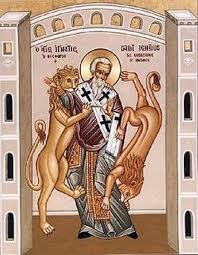
We now come to St Ignatius’s Epistle to the Ephesians. This is the longest of the epistles, and in many ways the most important. His name is given first: “Ignatius, who is also called “Theophorus,” to the Church, worthy of all felicitation, which is at Ephesus in Asia – blessed with greatness by the fulness of God the Father, predestined from eternity for abiding and unchangeable glory, united and chosen through true suffering by the will of the Father and Jesus Christ our God, – abundant greeting in Jesus Christ and in blameless joy.” (preface)
It is hard for us to understand this. If we look at it closely, word by word, we will see how strange it is to our present way of thinking. He treats the Church as an organic being, an entity in its own right, which has a history stretching all the way back to the beginning of time, with a destiny given to it by God.
Further, just like a human being, the Church has a being-state, a state of grace and blessedness. In this case, St Ignatius says, the Church is blessed with greatness, the Greek word being megethos, meaning the “quality of exceeding a standard involving physical magnitude,” and the “quality of exceeding a standard of excellence, (hence) greatness.” That is, the Church is not just an entity, it is one which exceeds standards of excellence and size. The Church is a cosmic being; it is bigger than this world. We are truly fortunate to be part of it, for by that fact we are taken up into something eternal, filling all of time and space.
Note that the Church is blessed with the “fulness” of the Father. The word for “fulness” used here is pleroma. A pleroma is “that which fills”, “that which makes complete,” that which is full, and also the state of being full. We do not speak that way, today, and so we tend to skip over these phrases. But it relates to the megethos or size of the Church, it is incorporated into the fulness of God. What this means, I suggest, is that while God is all-present, He is active in the Church in a special way: He gives her all of Himself. Those outside the Church can seek and approach Him. They see signs of His existence and goodness. Those inside the Church possess Him: they live with the knowledge of His existence and in the conscious experience of His goodness. Fundamental to this theosophy, or God-wisdom, is a vivid sense of the difference between the divine and the earthly. Whatever he may believe in, it is clear that His faith in God is so prominent in Ignatius that this world is utterly secondary for him.
For this reason, he writes in chapter 13, that they should: “Seek to come together more frequently to thank and glorify God,” the word being used also meaning the Eucharist of God. He states that when they do so frequently, “the powers of Satan are destroyed., and his mischief is brought to nothing, by the concord (or harmony) of your faith. There is nothing better than peace by which every war in heaven and on earth is abolished.”
This in its turn can be related to chapter 19, where he says that by the birth of Christ, “all magic was dissolved and every bond of wickedness vanished away, ignorance was removed, and the old kingdom was destroyed … Hence all things were disturbed, because the abolition of death was being planned.” Three mysteries were produced in the lifetimes of Christ, wrought in the silence of God, and hidden from the prince of this world, namely the devil: Mary’s virginity, the Nativity of Christ, and His death. The silence or stillness of God is Ignatius’ way of referring to a reality which is higher than anything we know, and so is manifested not in speaking and words, noise and action, but in the tranquillity which accompanies the fulness of God. This, I suggest, is the greatness, the megethos which is beyond the reach of any evil powers.
If you take all this together, you see that St Ignatius is assuming that the earth is a battleground for spiritual powers, and that some earthly forces are arrayed on each side. That is, the supernatural dimension of existence must never be forgotten or underestimated; but also, that the victory belongs to God, although here on earth it is still being worked out.
Now, St Ignatius also mentions the blood of God, saying: “you are imitators of God and have rekindled, through the blood of God, the work we share as members of the same family, and brought it to perfect completion” (1.1). This raises some questions:
- What does it mean to be “imitators of God”?
- How have they used the blood of God?
- What is the family work that has been rekindled?
- And what is the “perfect completion” he refers to?
The imitation of God is a key consequence of typology, because we here on earth are created according to a divine design, which has been disfigured by sin, Our best hope for salvation is to be conformed to that image both through God’s grace (the help from above) and our cooperating with that grace by striving to live like Christ. If the family he refers to is the Christian family which meets for the Eucharistic celebration, and that is their work, then it seems he is saying that their Divine Liturgies has been interrupted, but now have commenced again, and so once more the miracle of the Body and Blood of God is confected upon their altars. Then he writes: “… you were eager to see me, since you heard that I was being brought in chains from Syria because of the name and hope we share, and that I was hoping, through your prayer, to be allowed to fight the beasts in Rome, that by doing so I might be able to be a disciple.” (Ephesians 1.2)
We do not know, but I suspect that this means that St Ignatius wanted not to be beheaded, as legend tells us St Paul had been, but rather, to share the more horrific fate of those who were fed to the animals. If he was of Latin background, and maybe was of a good family, beheading would be expected.
This brings us to the question of his name, Ignatius called Theophorus, meaning “God-bearer”. It could be a name taken at baptism, but then, why do Polycarp, Irenaeus and Origen refer to him as “Ignatius” and never “Theophoros”? It is a mystery. Neither is the significance of his Latin name “Ignatius” known. It is a Greek form of a Latin name. It is also noteworthy that he is the only writer referred to by the dictionary, BDAG, as having used the Greek word exemplarion, a loan word from the Latin exemplarium, “a (living) example,” “an embodiment,” and he does so three times: in Ephesians 2, Trallians 3 and Smyrnaeans 12.
Was he of a Latin family? It is possible that we have overlooked a Latin influence, and that Ignatius himself was not only Gentile but had a family connection with Rome or at least the Latin empire. Interestingly, a much later Syriac writer, Bar Hebraeus, twice refers to him as “Ignatius the fiery” (Ignatiyus nurono), and says that Ignatius: “saw two the angels singing in two choirs facing each other, and instructed that the same thing should be done in the churches.” This is punning on the Latin word “ignis” which means “fire,” although the Latin name commences with an E not an I. However, it is a nice way of pointing to the uncompromising character of his epistles, and it may well be that he had some role in the organisation of chant in the Divine Liturgy.
Ignatius makes much of having seen Onesimus the bishop of Ephesus, and Burrhus their deacon, together with Crocus, Euplus and Fronto who would appear to be laymen (1.3 and 2.1). He relates this to their being made holy “in all respects … through a single subjection, being subject to the bishop and the presbytery”. (2.2) He returns again to their unity through obedience to the bishop (3.2). Here he urges them to “run together with the mind of God.” In other words, God directs our efforts when, like athletes we run the race of life. This is related to the idea that the bishops share in the mind of Jesus Christ, and He in the mind of the Father. This establishes a hierarchy which acts as a sort of ladder from the earth to the peak of heaven. Although he uses different words, it also ties in with St Paul in 2 Timothy 4:7: “I have competed in the noble contest; I have run the race; I have kept the faith.” He returns to this central idea: “… run together with the mind of the bishop … For your presbytery … is attuned to the bishop as strings to the lyre. Therefore Jesus Christ is sung in your harmony and symphonic love. And each of you should join the chorus, that by being symphonic in your harmony, taking up God’s pitch in unison, you may sing through Jesus Christ to the Father, that he may both hear and recognize you through the things you do well, since you are members of his Son. Therefore it is useful for you to be in blameless unison, that you may partake of God at all times as well” (Eph. 4.1-2, translation amended for accuracy)
It is good to ponder what Ignatius is saying, because it is easy to miss it: he is teaching that we ourselves come into the sight of God when we become part of the Son. That is, he is not saying that God sees each and every one of us, at all times, but that we become apparent or visible to Him when we are joined to His Son. It is a very interesting idea. This then gives new meaning to the next paragraph: “For since I was able to establish such an intimacy with your bishop so quickly (an intimacy that was not human but spiritual), how much more do I consider you fortunate, you who are mingled together with him as the church is mingled with Jesus Christ and Jesus Christ with the Father, so that all things may be symphonic in unison” (Eph. 5.1)
In chapter 5, he quotes James 5 and 1 Peter 5, to the effect that “God resists the proud.” He does so in the context of saying that it would be pride to hold ourselves aloft from the Church: rather we must be within the Church to have the bread of God: a clear reference to the Eucharist and to the fact that even then, it was known that the Eucharist was a sacrament or mystery of the Church.
But let me now offer a thesis as to why the Epistle to the Ephesians was written: namely, that when the five Ephesians came to see him, they asked him to write to their church; possibly because they had division and friction in the church, and they hoped his words – the words of a man going to witness to Christ with his own blood – would have a special power with their congregation. Hence, in the letter, he says “I do not give you commands as if I were someone great, for though I am a prisoner for the Name, I am not yet perfect in Jesus Christ” (3.1). In other words, the reason he has the right to speak to them as if giving a command is because he is about to give his life. This ties in with the extraordinary respect given to the martyrs and their relics in the early Church.
To close , let me cite the last words of chapter 20. He is urging them to come together in faith and in Christ, whom he calls: “… the Son of Man and the Son of God, so that you obey the bishop and the presbytery with an undisturbed mind, breaking one bread, which is the medicine of immortality, the antidote that we should not die, but live for ever in Jesus Christ.”