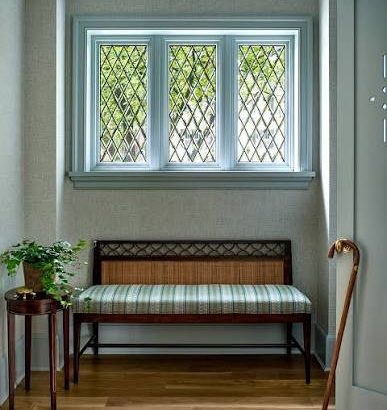
As my third example of typology, let us consider this diamond-patterned window pane. All of the complete diamonds are exact copies of the other, although they are in different places. If I take one of the diamonds, and the two diamonds beneath it, and the bottom diamond which joins those together, I have one larger diamond, which is a perfect model of any one diamond. That is, they are one in their proportion, and so they fit together. Each part of the pattern reflects the pattern of the entirety, yet all are needed to fulfil the divine purpose. I see outside by means of the diamonds. If I only look out of one, I can only see a portion of the grounds, perhaps only the house, or some leaves and a window, or some of the ground. But the more of the diamonds I hold in sight, the more I see the one picture. And that one picture is truer to reality, more informative, and more meaningful, than any single portion of the view.
In the same way, typology is a thinking which considers not only the design on the wax, or the appearance of the bust, or one diamond and what we can see from it, but rather, always looks for the archetype: the origin and the source of the sight we are seeing. It invites us to widen our gaze and see more of the diamonds, so that we may see more of reality. In other words, the typological way of thinking points to the meaning of the whole design: to the archetype, and to see in the antetype the more or less faithful reproduction of the archetype.
This way of thinking contradicts materialism: typology says that man is not just an animal. We are made in accordance with the divine design, made to live as images of God, following His divine plan. We want not to be like soft wax, too weak to hold the seal of its maker, or like hard wax, too rigid to receive it. We want to be obedient so as to receive His mark, and to persevere in virtue so as to maintain it, despite all the odds. Our glory is to reflect His glory, for His seal is His Holy Name. We want to humble like the diamond in a window, to understand both that we have a unique role to play, and also that it is not we alone who matter in God’s design. We are only small. We are a model from the hand of the Creator.
Finally, I will only touch on certain aspects of typology to indicate in general terms the width of its application. It is the basis of Christian ethics; it is the principle of mutuality. In Matthew 5:48, we read: “Be you therefore perfect, as also your heavenly Father is perfect.” Why should we be perfect just because He is? The answer is obvious to us now: because He is the archetype from which we were made. God is the seal and the seal-maker, His own image is on the metal head of the seal (see Genesis 1:26-27), and we are designed to bear His image. From this principle, we can develop, for example the Golden Rule (“Do unto others whatever you would have them to do unto you”), because this principle takes a type: (whatI wish for myself), and takes from it the antetype (what I do to others). It is the basis for the imitation of Christ and the saints, saying that this imitation is not just a good idea, it is God’s design.
In theology, typology clarifies passages in the Maronite Liturgy, e.g.: “For our salvation you sent your Son into the world; he descended, became flesh, suffered, and was crucified for us, who had distorted his image.” That is, we are poor reflections or antetypes of God’s image. As stated, we have only begun this study. These examples are only intended to indicate how far typology extends. It has this special advantage: everyone can use it from their own unique perspective, and ideas of right and wrong do not apply the same way here as in Western theology. Typology will take us far, even to seeing the hand of God in creation and ourselves.
part I is here: https://www.fryuhanna.com/2020/09/03/types/
part II is here https://www.fryuhanna.com/2026/09/16/understanding-types-and-typology-pt-ii/
The three parts are short, so I could have three illustrations