1 October 2026
We are presently celebrating the Maronite Season of the Holy Cross. Unlike the Latin Church, we have no “Ordinary Time.” Our liturgical calendar commences with the Sundays of the Consecration and Renewal and of the Church, and revolves not around the sun but the Mysteries of Christ; proceeding Season by Season until we arrive at what we might call the “Transfiguration of the Church,” the Season of the Holy Cross. In this way, not one day of the year is an orphan: each is related to the historical narrative of salvation, as exemplified by its due Season, and celebrated by the Church.
As the feasts of the Consecration and Renewal of the Church call us to participate in the sanctification and abiding of earthly creation through and in the Church, so the Season of the Holy Cross brings before us the reality that all life must be cleansed, remade, lifted up and made holy through the Cross of Christ, for “nothing unclean shall ever enter [heaven]” (Apocalypse 21:27).
In the oldest surviving copy of the Maronite Divine Office, found in the Bet Gazo (“the treasury”), dated to 1263, there are an abundance of hymns and psalms testifying to the universal power and significance of the Cross; so that we are left in no doubt except that the Cross abides as a mystery in eternity.
One of these, called “A New Rogation” prays: “Grant to me, Our Lord, to speak forth the genealogy of Your Cross of Light, / How many miracles flow from it for those who dwell in contemplation of it, / How the shining Cross clothes the worshippers in light; / and draws for them water from the depths, raising it up.”
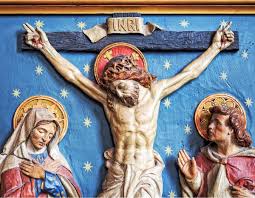
A distinguishing feature of Syriac Christianity is how the Cross of Christ is not merely a symbol. It is an abiding entity. The Cross on which Our Lord was crucified is, in Syriac Christianity, as one Latin Cardinal remarked with amazement, a reality.
To speak of the Cross is not merely to engage in a figure of speech. It is common today, in psychologically aware circles, to speak of symbols and of archetypal images; to opine that these haunt us in the depths of our unconscious minds, emerge in our dreams, and influence our actions and thoughts. We are not speaking of this, but of something supernatural. In the ancient Semitic tradition, clear signs of which are evident on almost every page of the Bible, creation is according to the divine plan or model. Matter (cognate with the word “mother”) is imprinted by God’s pattern (cognate with the word “father”, hence “paternal.”) Everything which is or has been on earth, including the Cross, is a reflection or antetype of an original or archetype in the mind of God.
We read both the heavenly original and the earthly copy of these patterns in Scripture. That is what makes Scripture special. No matter how imperfectly we do so, this is the ultimate reason we meditate on Scripture, to align ourselves and conform our minds to the divine design of creation and salvation. We also act out these patterns, or more precisely, the most sacred of them in the Divine Liturgy. This is the Mystery of the Sacraments.
The divinely ordained relationship between heaven and earth, the spirit hidden within the body, is recognized in the Maronite Bet Gazo: “[Contemplating] the Cross interprets [to us] every Word which it has spoken. It has enlightened us concerning all the secrets hidden within it. The Cross is the seal of all the mysteries of prophecy; for in it are expressed all the sights which have been hidden.”
The solution of the riddle of the Cross then, is that, in God’s plan, the Cross is an indispensable instrument for our salvation, and so it was ordained as an eternal reality. The earthly Cross on which Christ was crucified was but the earthly shadow of a shining divine reality. But, it was still a shadow—and that is not nothing!
When Maronites hymn the Cross in our Divine Office, and in the liturgies of the Season of the Cross, we are praising God both for the resplendent celestial Cross, the archetype which He ordained at the very beginning of our fallen human history, and for the antetype, or rather the antetypes, plural. Our crosses are not of the level of that on which Our Lord was crucified, but they are of that pattern. In this Season of the Holy Cross, we are called to choose, with free will, to follow that pattern. We are summoned, in divine joy, to accept the crosses we are sent, and with them, the Cross which is above all crosses; to join Christ Our Lord in the carrying of it.